


Cecil Lee
Staff
-
Joined
-
Last visited
Everything posted by Cecil Lee
-
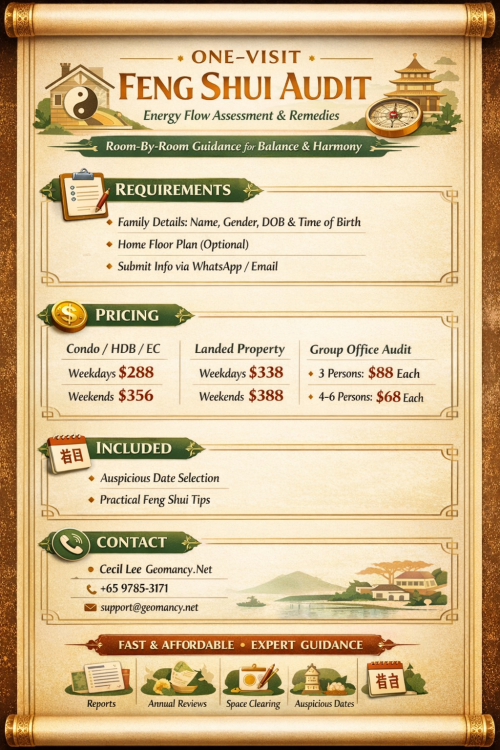
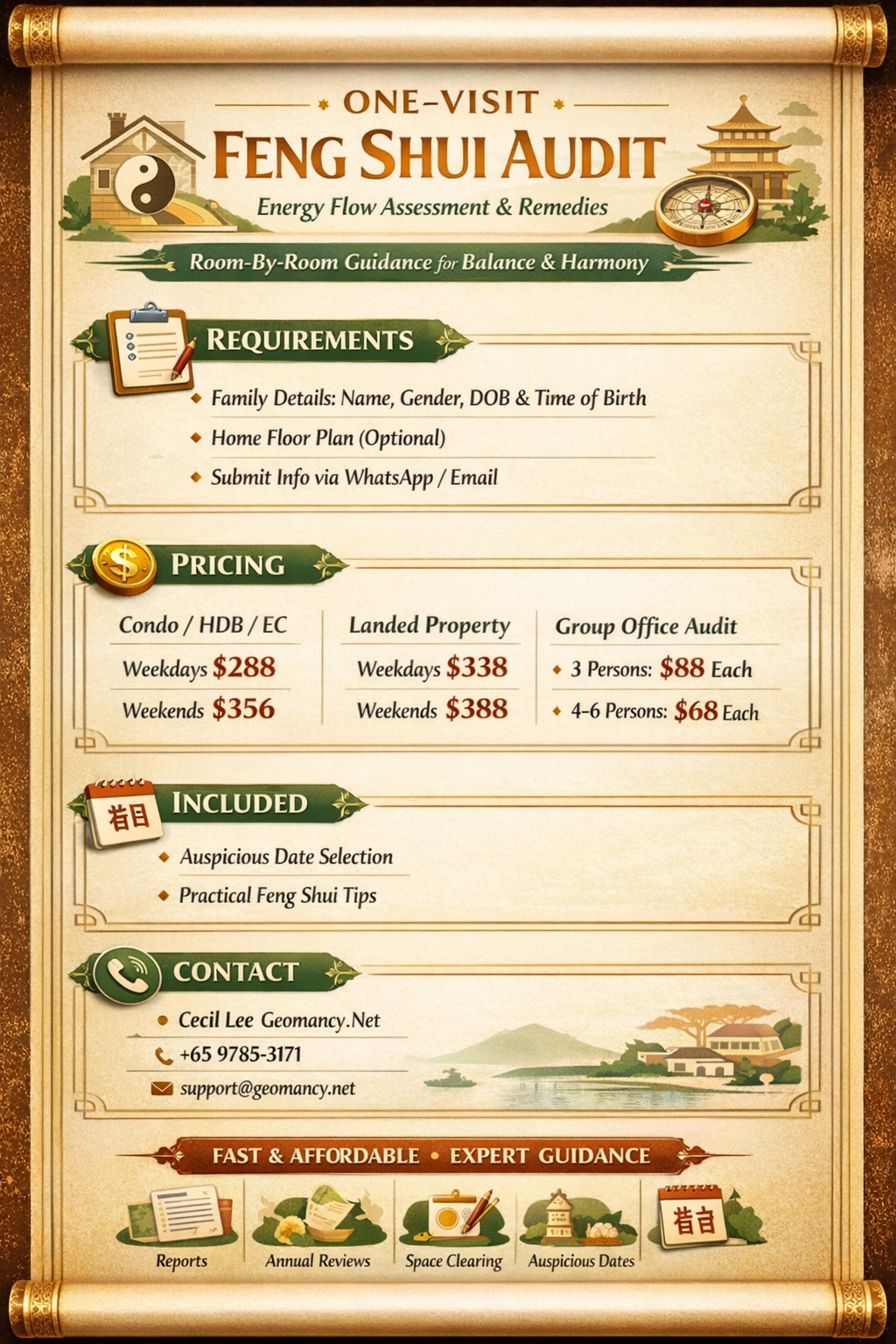
Cecil Lee commented on Cecil Lee's blog entry in FAQ: Home Feng Shui / Cannot Cannot Buy / Baby Name / Auspicious DatesHere are the main points from this page: 🌿 One-Visit Feng Shui AuditPurpose: A single-session home audit to identify energy blockages and provide practical fixes for balance, clarity, and peace of mind. Process: Consultant walks room-by-room with the client, offering immediate recommendations. Clients may need to take notes. Inclusions: Auspicious date selection is part of the service. 📋 RequirementsFamily member details: name, gender, date & time of birth (Western calendar preferred). Home layout plan (optional for rental units, but recommended). Contact via WhatsApp/email for submission of details. 💰 PricingCondo / EC / HDB / EA: Weekdays: $288 Weekends/Public Holidays: $356 Cluster / Landed Properties: Weekdays: $338 Weekends/Public Holidays: $388 Group Office Audits: 3 persons: $88 each (minimum $264) 4–6 persons: $68 each 📞 ContactCecil Lee, Geomancy.Net Phone: +65 9785-3171 Email: support@geomancy.net 🔑 Additional OptionsComprehensive Feng Shui reports, off-site consultations, rental unit assessments, and COVID-safe packages. Add-ons: annual reviews, auspicious date selection, space-cleansing rituals.
-
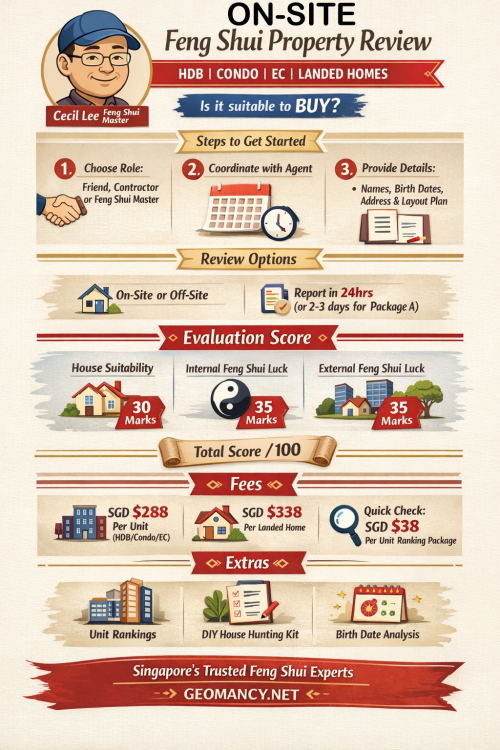
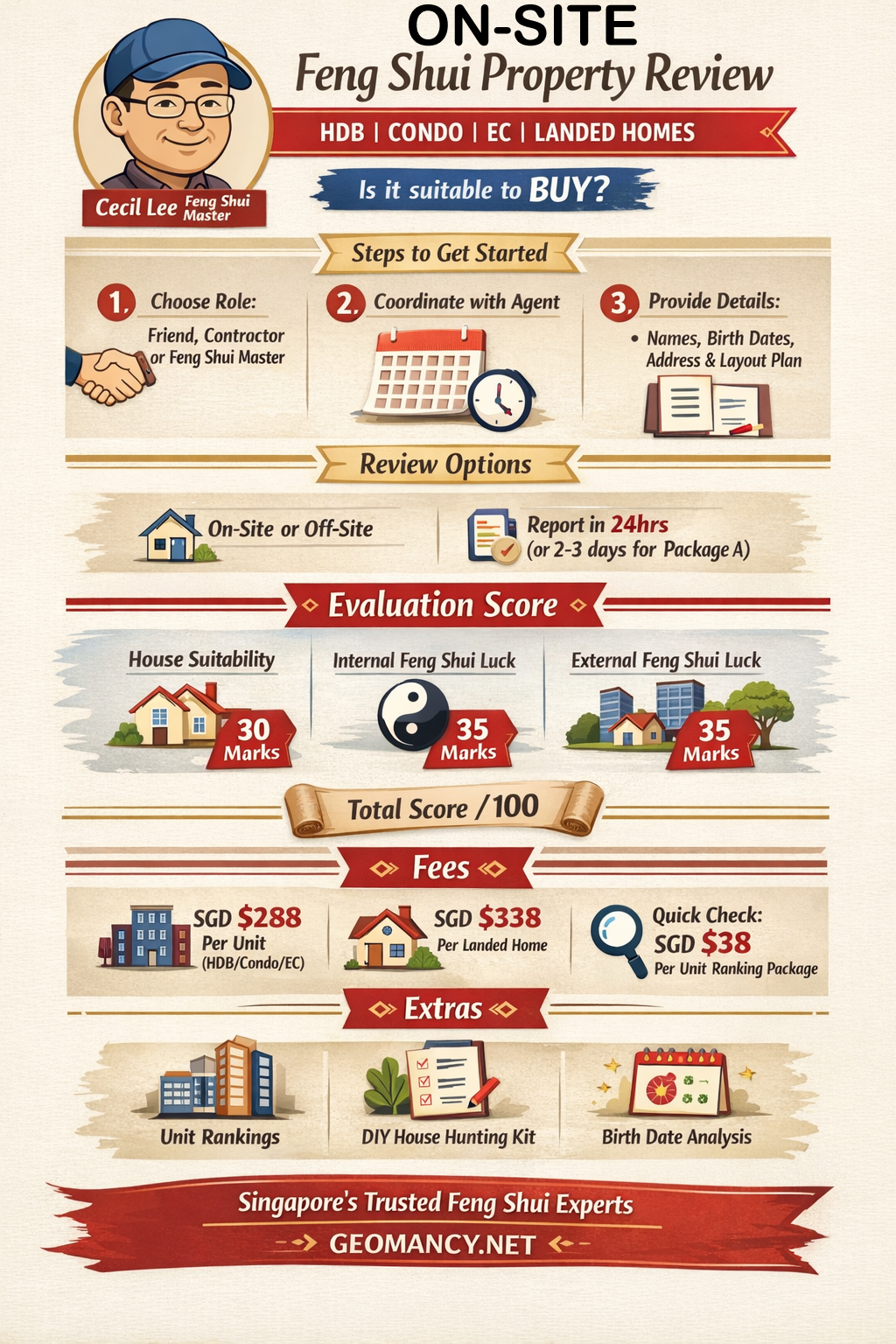
Cecil Lee commented on Cecil Lee's blog entry in FAQ: Home Feng Shui / Cannot Cannot Buy / Baby Name / Auspicious DatesHere’s a concise summary of the main points from this page: 🔑 Key TakeawaysPurpose of Service: Professional Feng Shui reviews for homes (HDB, condo, EC, landed property). The aim is to assess whether a unit is suitable for purchase. Process: Decide Cecil Lee’s role (friend, contractor, or Feng Shui Master). Coordinate with the property agent and confirm availability. Provide family details (names, gender, birth dates, breadwinner info), full address, landmarks, lease/T.O.P. date, and layout plan. Review Options: On-site or off-site reviews available. Reports typically delivered within 24 hours (or up to 3 days for Package A). Evaluation Method: House suitability (frontage, kitchen, main bedroom) – 30 marks. Internal Feng Shui luck – 35 marks. External Feng Shui luck – 35 marks. Overall score out of 100. Fees: SGD $288 per unit (HDB/Condo/EC). SGD $338 per landed home. Alternative ranking package: SGD $38 per unit, covering multiple units quickly. Additional Features: Rankings of units in new developments. DIY house-hunting kit (“Can or Cannot Buy” checklist). Birth date review included in some packages. Reputation: Geomancy.net is described as a long-standing market leader in Singapore’s residential Feng Shui audits. In short, the page outlines how Master Cecil Lee provides structured Feng Shui assessments for property buyers, with clear steps, scoring criteria, and package options.
-
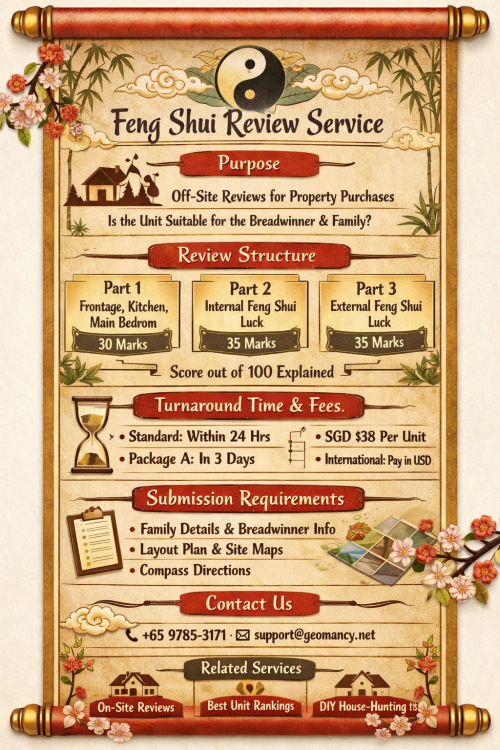
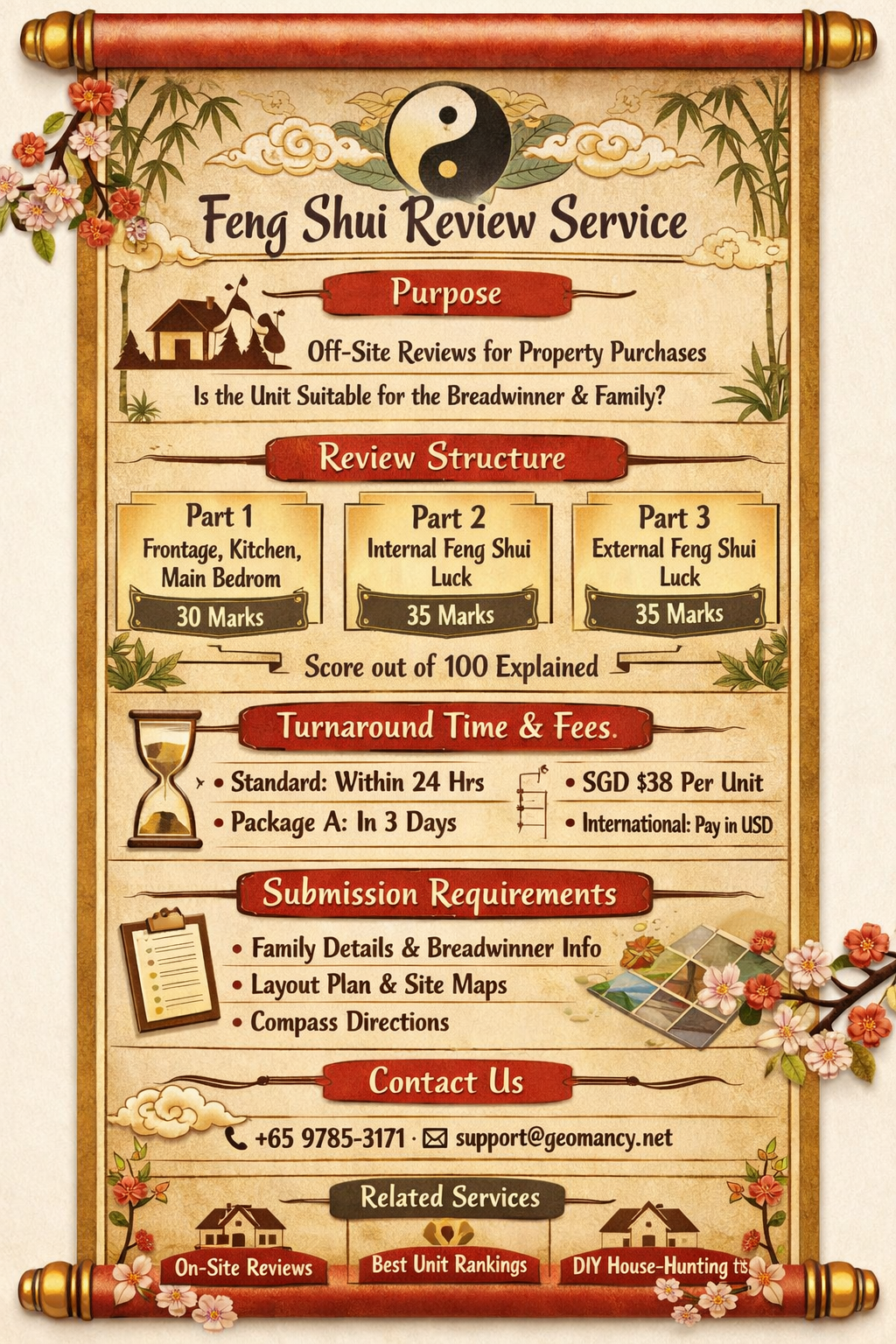
Cecil Lee commented on Cecil Lee's blog entry in FAQ: Home Feng Shui / Cannot Cannot Buy / Baby Name / Auspicious DatesHere’s a clear summary of the main points from this page 🌿 Purpose of the ServiceOff-site Feng Shui reviews for potential property purchases. Helps determine if a unit is suitable for the main breadwinner and family. 📋 Structure of the ReviewPart 1 (30 marks): Suitability of frontage, kitchen, and main bedroom. Part 2 (35 marks): Internal Feng Shui luck. Part 3 (35 marks): External Feng Shui luck. Overall: Scored out of 100 marks, with explanations of why the score matters. ⏱️ Turnaround & PackagesStandard reviews usually completed within 24 hours (if submitted before 2pm, Mon–Thu). Package A: Guarantees completion within 3 days and provides more detailed insights. Package B: Fees: SGD $38 per unit (recommended max of 8 units per review). International clients pay in USD. 📑 Requirements for SubmissionFamily member details: name, gender, date/time of birth (Western calendar preferred). Identification of the breadwinner (usually male). Layout plan and site maps (especially for older developments). Compass direction checks are part of the review. 🧾 Additional NotesReviews may be updated; formats evolve over time. Case studies show examples of unsuitable units (e.g., health concerns, inauspicious kitchen layouts). Service does not include detailed explanations of rankings unless Package A is chosen. Contact via WhatsApp, phone (+65 9785-3171), or email (support@geomancy.net). 🏠 Related ServicesOn-site home viewing reviews. Rankings of best units in new launches. DIY house-hunting kits and checklists.
-
Comprehensive Feng Shui House Audit: Full Home Report for Renovation, Wealth, Relationships & Health
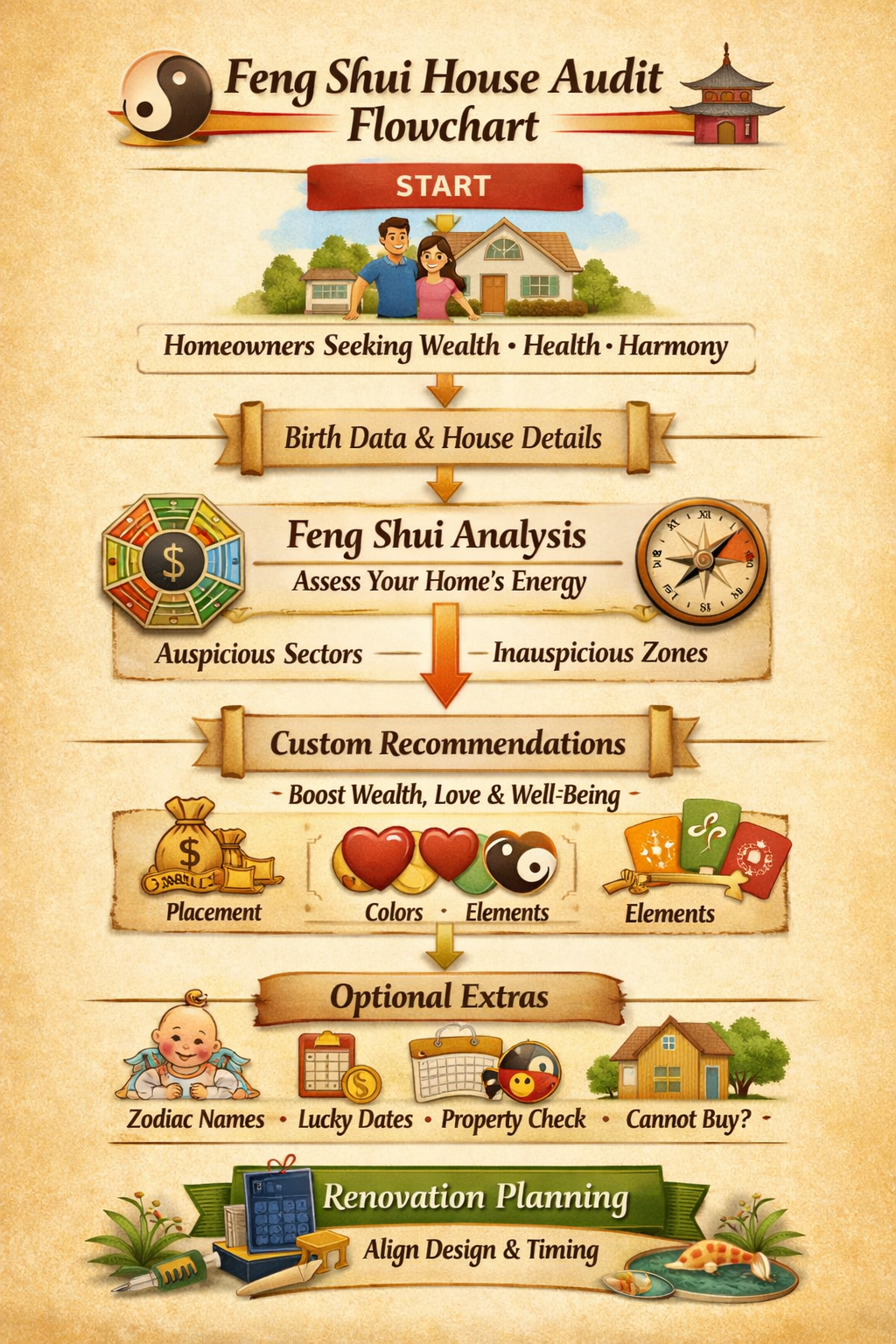
Cecil Lee commented on Cecil Lee's blog entry in FAQ: Home Feng Shui / Cannot Cannot Buy / Baby Name / Auspicious DatesA concise summary of the main points from the page you’re viewing on Geomancy.Net about the Comprehensive House Audit: 🏠 Purpose of the AuditThe service offers a full Feng Shui report for homeowners planning renovations or seeking improvements in wealth, relationships, or health. It’s designed to provide personalized guidance based on the home’s layout, orientation, and the occupants’ birth data. 📋 What’s IncludedA detailed analysis of the house’s Feng Shui chart, identifying auspicious and inauspicious sectors. Recommendations for enhancing prosperity, harmony, and well-being through adjustments in design, furniture placement, and elemental balance. Optional modules cover baby naming, auspicious dates, and property purchase suitability (“Cannot Cannot Buy” section). 💡 Practical UseThe audit helps homeowners plan renovations strategically, aligning construction timing and layout with favorable energies. It’s positioned as a professional consultation, not superstition—combining classical Feng Shui principles with modern living needs. 🌿 Broader InsightThe page emphasizes Feng Shui as a holistic system that connects physical space with emotional and financial health. It encourages viewing the home as a living ecosystem that can be tuned for balance and success.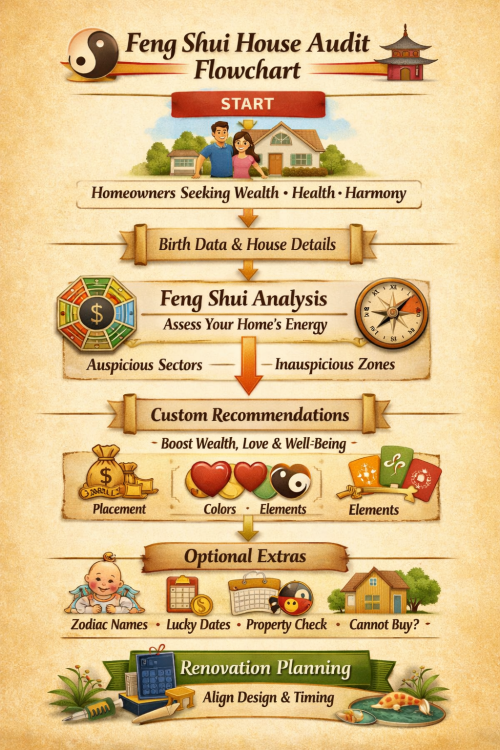
-
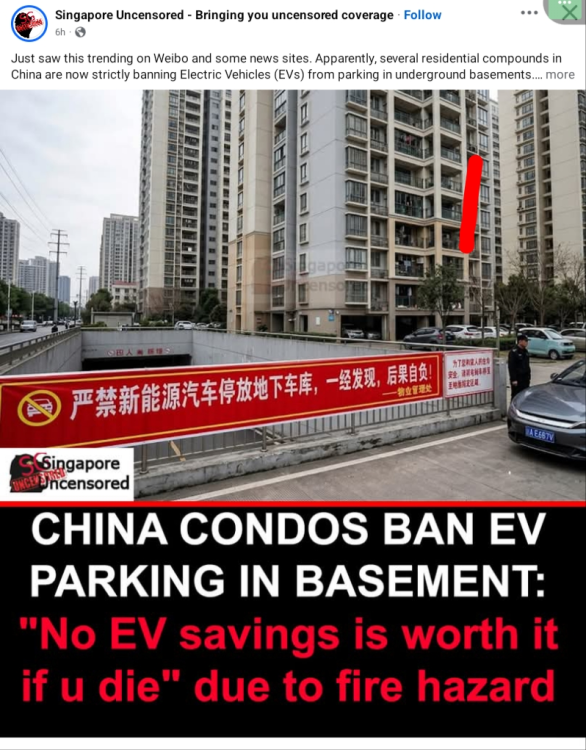
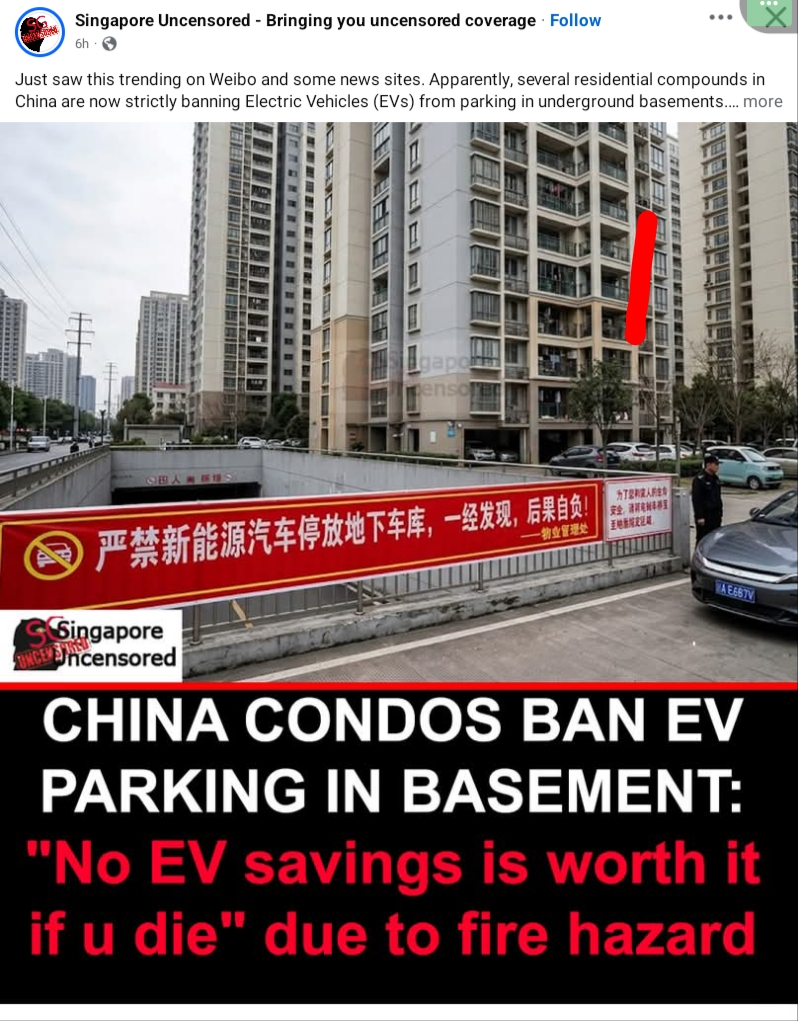
(C) Lovesigns.net 🔥 Sparks in the Basement: China’s EV Fire DilemmaWhen a blaze tore through BYD’s parking lot in China, engulfing test and scrapped electric vehicles, it wasn’t just a headline—it was a warning. The incident reignited debates about EV safety, particularly in dense urban environments where batteries and basements collide. 🚗 Condos vs. CarsIn several Chinese cities, condominium boards have begun banning EVs from basement parking lots, citing fire hazards and evacuation risks. For residents, this creates a paradox: the government promotes EV adoption, yet local rules restrict where they can be parked. It’s a clash between national policy and neighborhood safety. ⚡ The Battery QuestionLithium-ion batteries, the beating heart of EVs, are both revolutionary and risky. While rare, thermal runaway events can cause fires that are difficult to extinguish. Storing dozens—or hundreds—of EVs in enclosed basements magnifies the danger. The BYD fire is a stark reminder that scale changes the equation. 🏙️ Urban ChallengesThe bans highlight broader adoption hurdles: Charging access: Apartment dwellers often lack private charging stations. Safety protocols: Fire departments need new training and equipment for EV-specific risks. Insurance and liability: Who pays when a condo fire starts with a car battery? 🔄 Hybrids as a Middle PathSome argue that hybrids (HEVs) and plug-in hybrids (PHEVs) offer a safer, transitional solution. They reduce emissions without fully relying on large battery packs, sidestepping some of the fire concerns while infrastructure catches up. 🌏 Global EchoesChina’s condo bans may foreshadow similar debates elsewhere. As EV adoption accelerates worldwide, cities from Singapore to San Francisco will need to balance green ambitions with safety realities. The question isn’t just how fast we electrify, but how safely. This piece positions the BYD fire and condo bans as part of a larger global conversation about EV adoption, safety, and urban planning.

-
Source and Credit
-
Source from the Internet Massive fire breaks out at BYD's parking lot in China containg test and scrapped electric vehicles +++ An EV isn’t the best fit for everyone. If it’s a “last resort” for you, what’s driving that most? A few common sticking points (tell me which apply and I’ll tailor options): - Charging access: no home charging, apartment/condo rules, unreliable public chargers - Road trips/towing: long-distance convenience, cold-weather range loss, towing/haul needs - Upfront cost / depreciation: price, insurance, repair uncertainty, battery longevity concerns - Lifestyle fit: you want quick refuel, minimal planning, or you just prefer ICE driving If you want non-EV alternatives that still cut fuel use without changing your routine much, usually the best “middle ground” is: - Hybrid (HEV): no plug, great MPG in town, normal fueling - Plug-in hybrid (PHEV): EV for short trips if you can charge, gas backup for everything else - Efficient ICE: modern turbo-4 sedans/hatches or small crossovers can be very economical


-
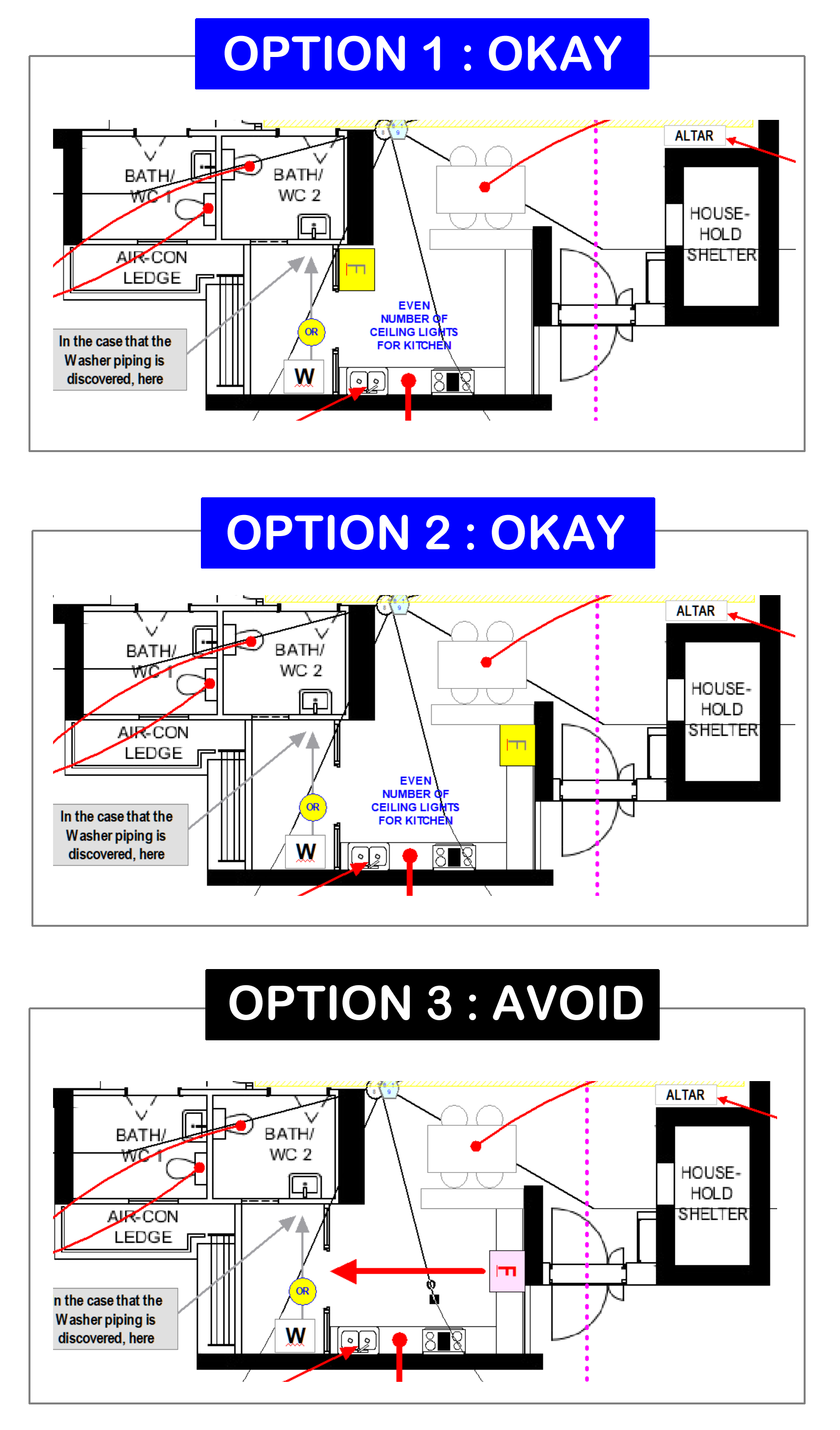
A fridge is best not face directly to either the door or the window, © Geomancy.net
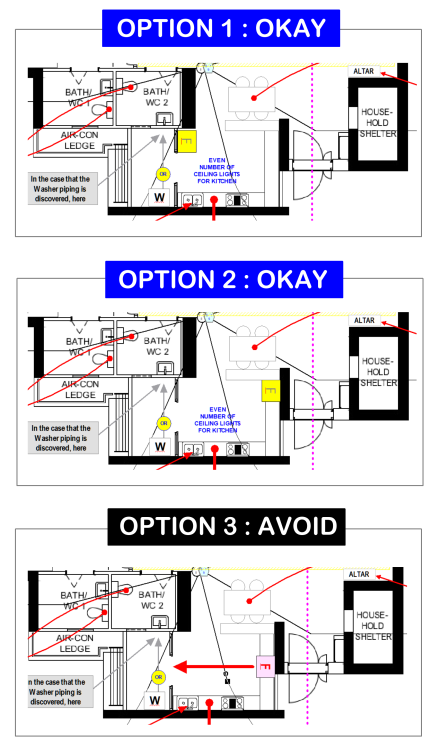
-
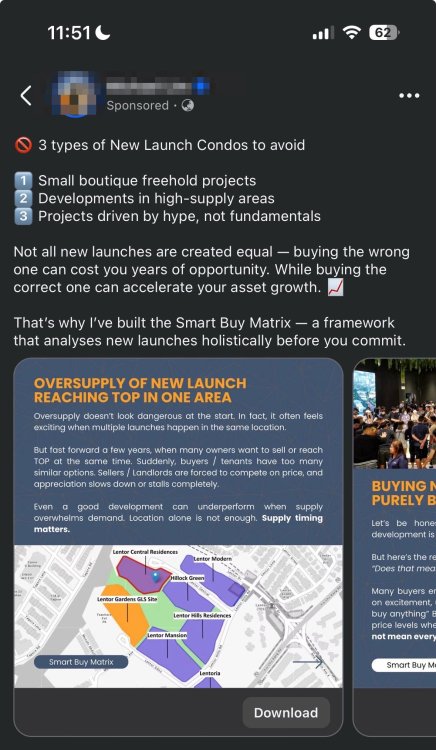
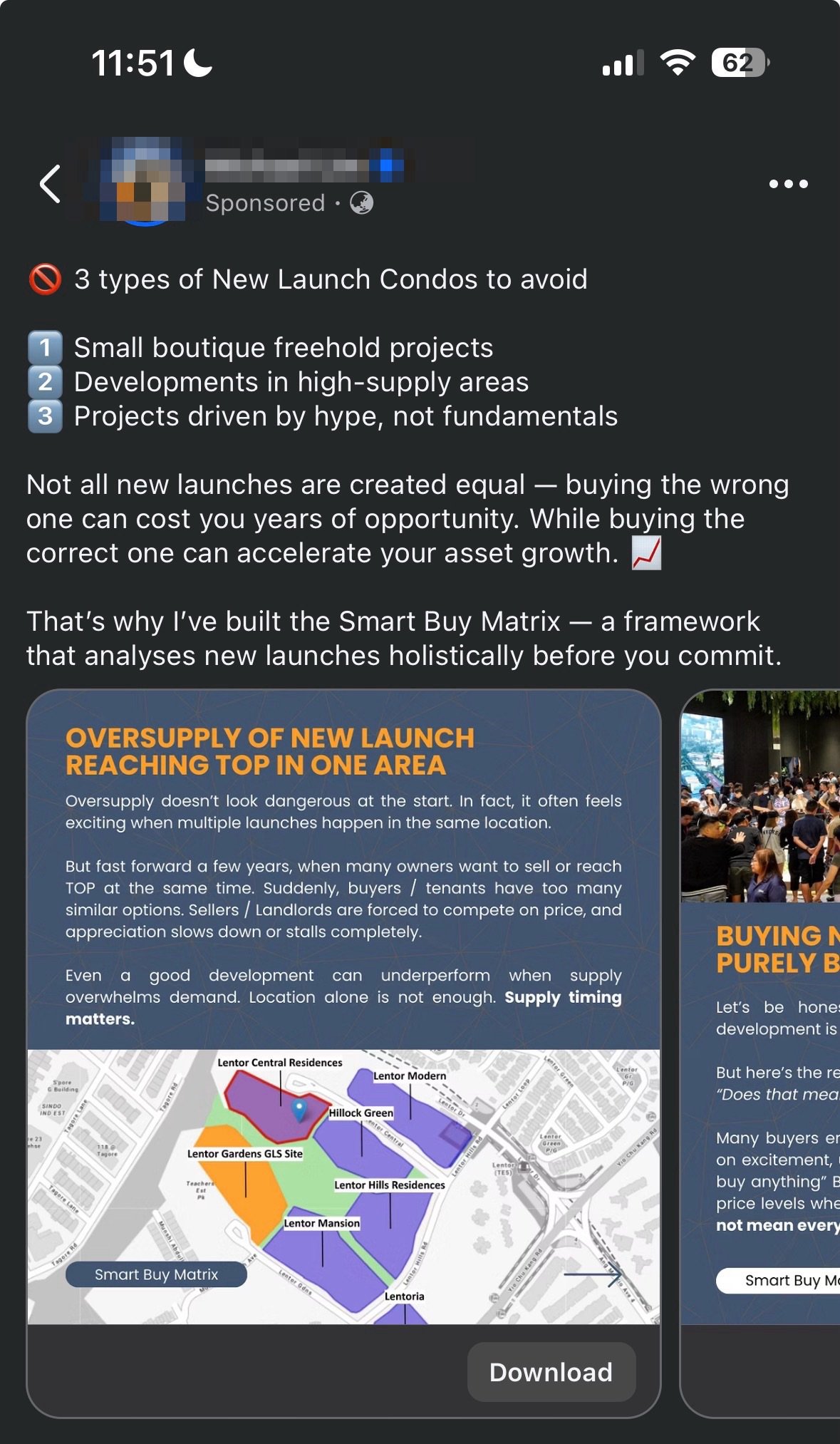
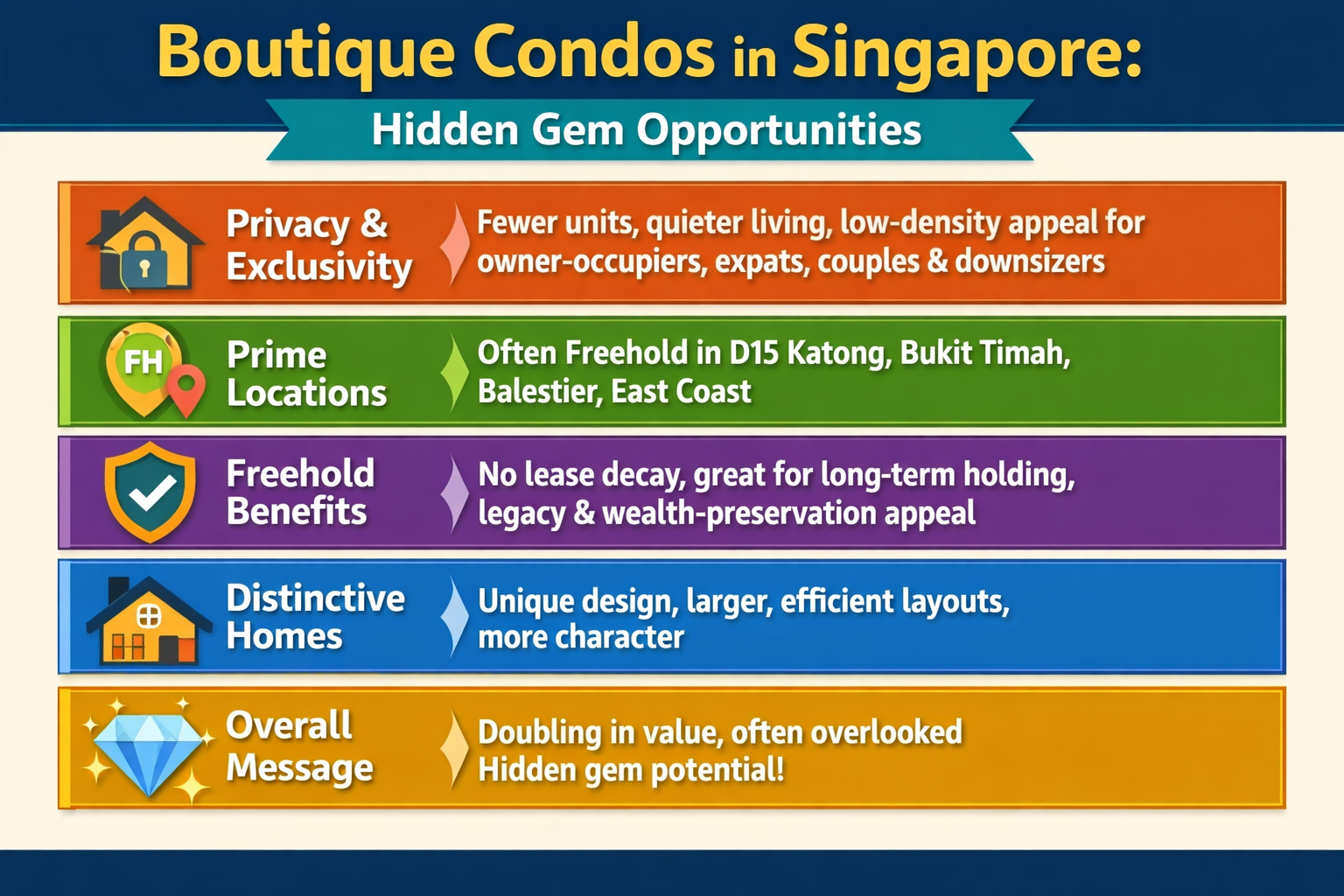
An AD that is Pro Boutique Condos Why Boutique Condos Are Singapore's Best Kept Property Secret The image is a social media advertisement promoting “boutique condos” in Singapore as an overlooked property opportunity. It claims some boutique condos have doubled in value, highlights that many are freehold, and markets them as “Singapore’s best kept property secret” with benefits like being quieter/less crowded, having unique designs, and being in premium locations. A call-to-action invites viewers to “Discover Singapore’s hidden boutique condo opportunities” with a “Learn more” button.

-
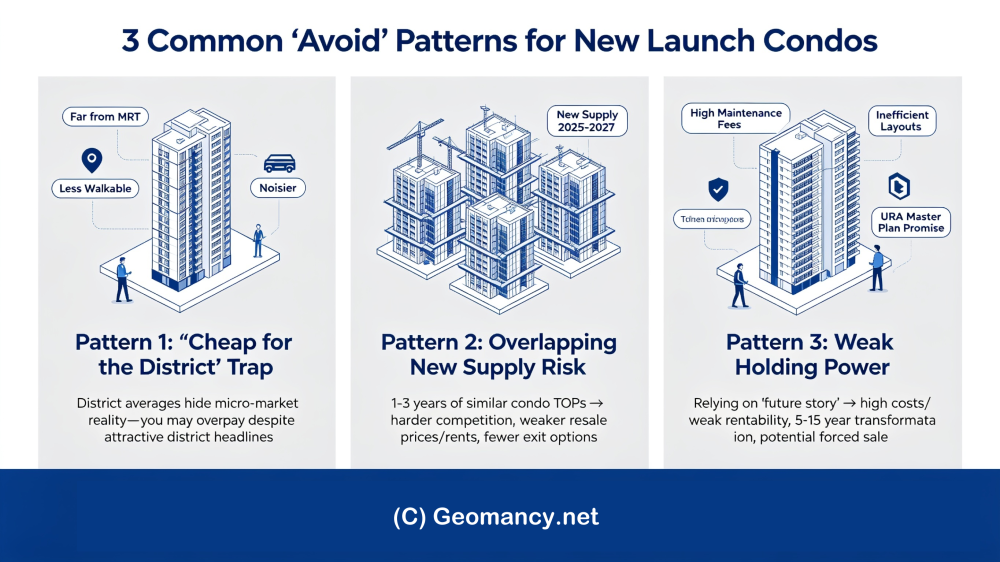
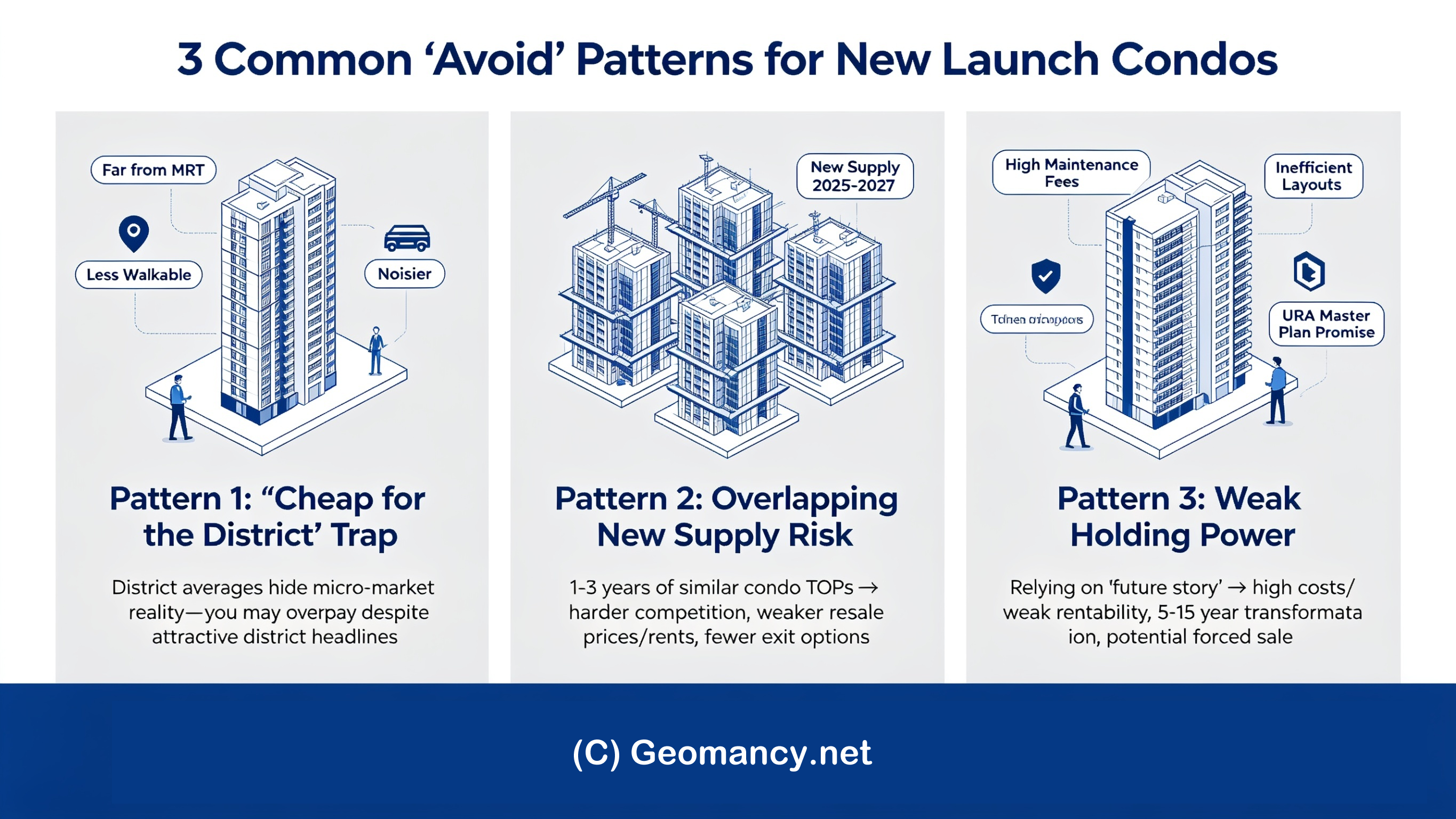
It seems not everyone agrees with the above on boutique condos. Three common “avoid” patterns for new launch condos A condo can look “cheap for the district” but still be overpriced for its exact location because district averages hide micro differences like being far from the MRT, less walkable, or affected by noise. Another common risk is too much nearby new supply completing around the same time (about 1–3 years), because many similar units hitting the market together forces sellers and landlords to compete harder, which can weaken resale prices and rents and make it harder to exit. A third risk is weak holding power, where high maintenance fees, inefficient layouts, or poor rental appeal mean you can’t comfortably hold the property in a downturn, especially if you’re relying on a “future transformation story” that may take 5–15 years to materialise and could already be priced in. As a rule of thumb, be cautious if a project fails two or more of these basics: a fair entry price for the micro-location, good exit liquidity based on real resale comparables, and strong holding power (rentability, reasonable costs, and an efficient unit).
-
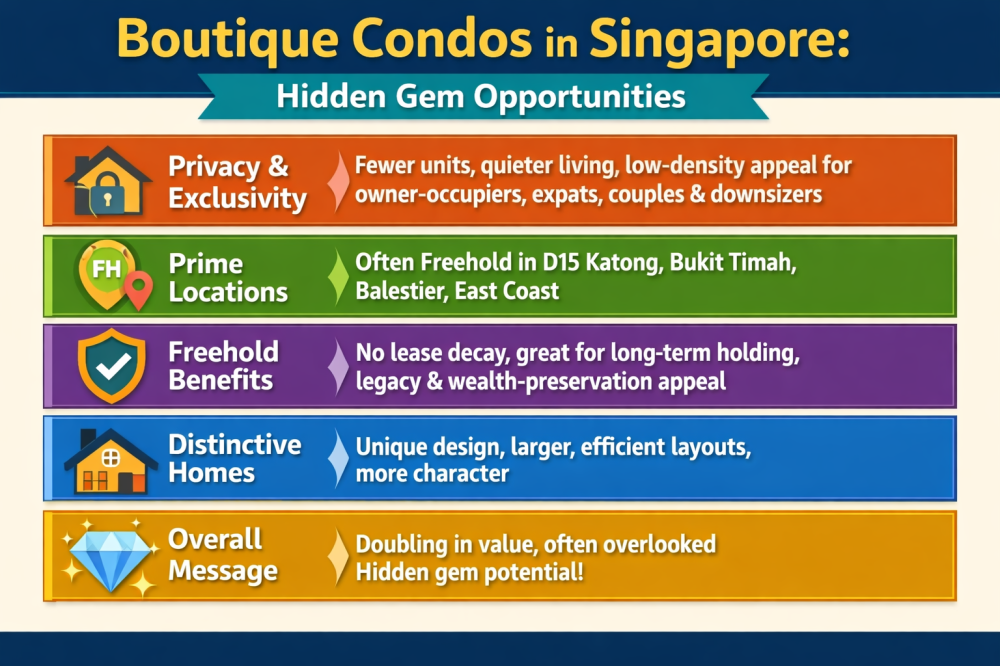
+++ Boutique condos in Singapore are often overlooked because most buyers focus on large, high-unit developments, but they can offer strong long-term value. Since 1996, (C) Geomancy.net Boutique Condos in Singapore Boutique condos in Singapore are small private condo projects with a low number of units, often found in city-fringe or prime, landed-adjacent neighbourhood pockets. Because there are fewer units and therefore fewer resale transactions, their pricing data can be “thin” meaning a handful of deals can make the “market price” look higher or lower than it really is. People buy boutique condos mainly for privacy and exclusivity. With fewer neighbours, the common areas tend to be quieter, and there’s usually less competition for practical things like lifts and parking. The trade-off is that boutique projects often come with fewer facilities than bigger developments; some buyers like this “facility-light” lifestyle, while others see it as a drawback compared to full-facility condos. Many boutique condos are marketed as freehold or 999-year, especially in older central areas, but that doesn’t automatically make them “better.” Tenure should be treated as just one factor among others, so it’s more useful to compare options within a tight radius by looking at tenure together with MRT distance, unit mix, and (for resale) the remaining lease, then observing which projects hold their pricing better over time. Boutique condos can also appeal because they feel more “distinctive,” such as being low-rise or having unique layouts and larger-format homes. However, that uniqueness can backfire: odd angles, long corridors, and wasted space can make layouts less practical, which may hurt resale demand and value retention when buyers compare them to more efficient, mainstream alternatives. In terms of appreciation, boutique condos tend to do well when scarcity and owner-occupier demand are strong, and when the micro-location (the specific street or pocket) is especially desirable. The best catalysts are practical improvements that increase accessibility, jobs, or amenities not just superficial beautification. Upside can be stronger when there are few close substitutes offering the same “feel,” which allows prices to be more story-driven and sustain a premium in good markets; the downside is a thinner buyer pool, which can mean weaker exit liquidity and choppier price discovery, with bigger gaps between transaction prices. Boutique-specific risks include liquidity and price-signal risk (few transactions create more price volatility), substitutability risk (a nearby new launch that looks like better value can cap resale demand), and cost/yield risk for investors (maintenance fees and facility offerings affect rental appeal too few facilities may limit tenant demand depending on the target segment). A simple way to evaluate them is to use a balanced scorecard that prioritises exit liquidity, downside protection, and holding power, and treat “nice-to-haves” like area transformation or school proximity as upside only if they aren’t already priced into the property. Examples of boutique condos (generally low unit count) that have been popular for resale demand Core Central / City fringe - The Lumos (D9, Leonie/Paterson area) – freehold, very low density; scarcity/positioning in prime area. - Cyan (D10, Keng Lee/near Novena/Newton fringe) – freehold, small project; strong “own-stay” appeal and central convenience. - One Draycott (D10, Draycott Park) – freehold, low density; prime-location scarcity. - The Boutiq @ Killiney (D9, Killiney Rd) – freehold, small development near Orchard/River Valley. East / D15 & nearby (many freehold boutique projects here) - Amber Skye (D15, Amber Rd) – freehold, low unit count; consistent demand due to Amber/Marine Parade appeal. - The Seafront on Meyer (D15, Meyer Rd) – freehold, low density; “Meyer address” scarcity factor. - The Line @ Tanjong Rhu (D15, Tanjong Rhu) – freehold, boutique; lifestyle/park/CCL connectivity helped demand. City / River Valley–Robertson - UP@Robertson Quay (D9) – freehold, small; niche expat/own-stay rental appeal due to Robertson Quay location. - The Botanic on Lloyd (D9, Lloyd Rd) – freehold, boutique; central location with limited supply. +++ This topic has nothing to do with Feng Shui. I am also not a Real Estate agent. I am simply, just like you, a property consumer who is interested in property trends in SG.



-
Other Related Property Articles: SG Property Article 1: The 3 Certainties of Property Transformation: A Professional Framework for Timing Your Entry https://www.geomancy.net/forums/topic/20897-the-3-main-signs-of-property-change-when-to-step-in-and-buy/ SG Property Article 2: A practical pro and cons review of how Singapore poperty is often assessed and sometimes marketed by real estate agents https://www.geomancy.net/forums/topic/20898-a-practical-pro-and-cons-review-of-how-singapore-property-is-often-assessed-and-sometimes-marketed-by-real-estate-agents/ SG Property Article 3: Boutique condos in Singapore are often ignored https://www.geomancy.net/forums/topic/20904-boutique-condos-in-singapore-are-often-ignored-because-most-buyers-focus-on-big-high-unit-projects-but-they-can-offer-strong-long-term-value/ SG Property Article 5: A buyer playbook using MAPS Investment screening process https://www.geomancy.net/forums/topic/20900-a-buyer-playbook-using-maps-investment-screening-process/ SG Property Article 6: Why 2026 matters for HDB owners who want to upgrade https://www.geomancy.net/forums/topic/20902-why-2026-matters-for-hdb-owners-who-want-to-upgrade-to-private-property-without-depleting-personal-savings/ SG Property Article 7: Your HDB Is Your Starting Point https://www.geomancy.net/forums/topic/20908-sg-property-article-7-your-hdb-is-your-starting-point/ SG Property Article 8: Reckless housing land bids? https://www.geomancy.net/forums/topic/20912-sg-property-article-8-reckless-housing-land-bids/ SG Property Article 9: HDB resale prices post first decline in nearly seven years https://www.geomancy.net/forums/topic/20919-sg-property-article-9-hdb-resale-prices-post-first-decline-in-nearly-seven-years/ SG Property Article 10: Ten Reasons why HDB Homeowners sell their flats https://www.geomancy.net/forums/topic/20942-sg-property-article-10-why-hdb-homeowners-sell-their-flats-and-what-it-says-about-life-in-singapore/ SG Property Article 11: Educational Infographic Ads Designed to Boost Engagement https://www.geomancy.net/forums/topic/20962-sg-property-article-11-educational-infographic-ads-designed-to-boost-engagement/ SG Property Article 12: A critical review of the common unit selection framework https://www.geomancy.net/forums/topic/20899-a-critical-review-of-the-common-unit-selection-framework-made-popular-by-singapore-property-influencers-and-agents/ SG Property Article 13: Condo owners may lose their apartment for owing maintenance charges https://www.geomancy.net/forums/topic/20952-condo-owners-may-lose-their-apartment-for-owing-maintenance-charges/ SG Property Article 14: HDB Lease Decay - By 2030, close to 500,000 HDB flats will be older than 40 years https://www.geomancy.net/forums/topic/20969-sg-property-article-14-hdb-lease-decay-by-2030-close-to-500000-hdb-flats-will-be-older-than-40-years/ SG Property Article 15: Failed “99-1” ownership scheme leads to costly lawsuit, highlighting stricter IRAS scrutiny and risks of trying to bypass Singapore’s ABSD https://www.geomancy.net/forums/topic/20878-sg-property-article-15-failed-99-1-ownership-scheme-leads-to-costly-lawsuit-highlighting-stricter-iras-scrutiny-and-risks-of-trying-to-bypass-singapores-absd/ SG Property Article 16: Star Buy Units in New Launch Condos: What They Really Mean + 5-Factor Checklist to Spot a Genuine Deal https://www.geomancy.net/forums/topic/20994-sg-property-article-16-star-buy-units-in-new-launch-condos-what-they-really-mean-5-factor-checklist-to-spot-a-genuine-deal/ Since 1996 (C) Geomancy.net


-
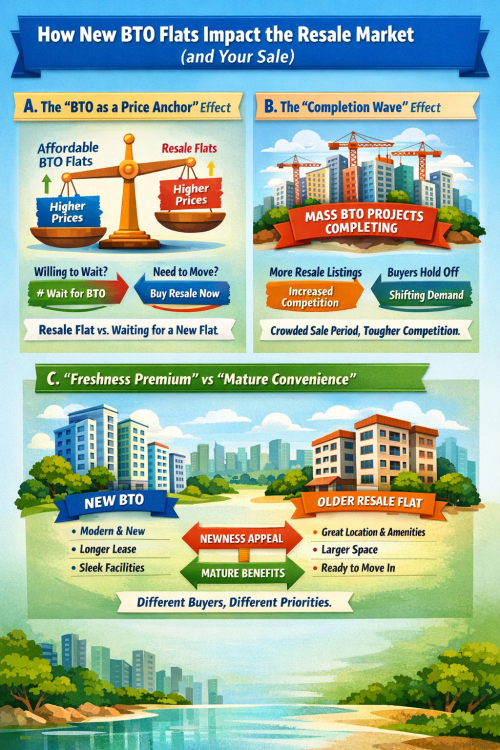
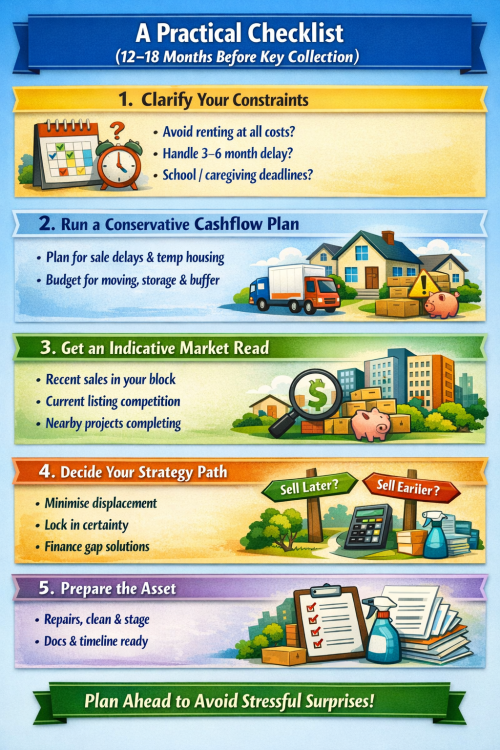
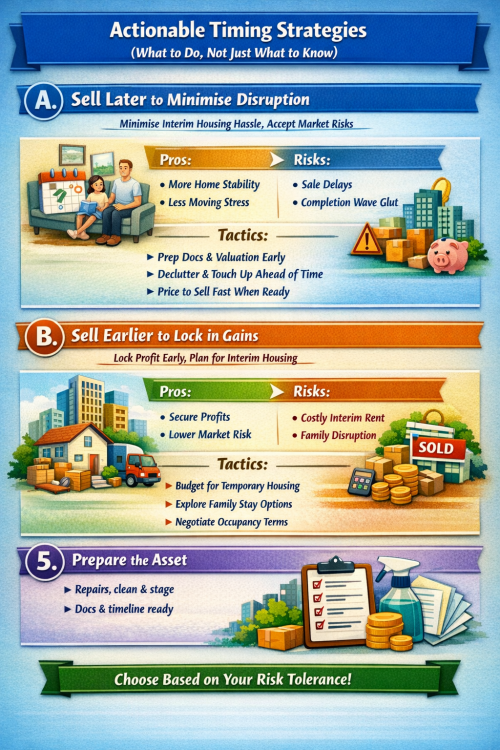
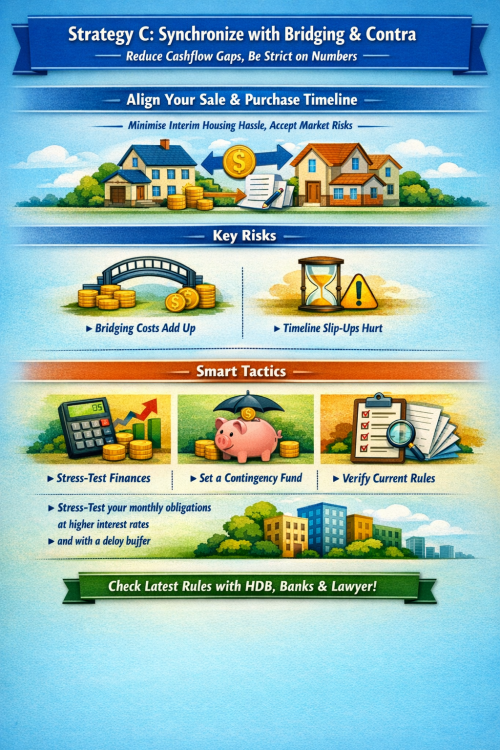
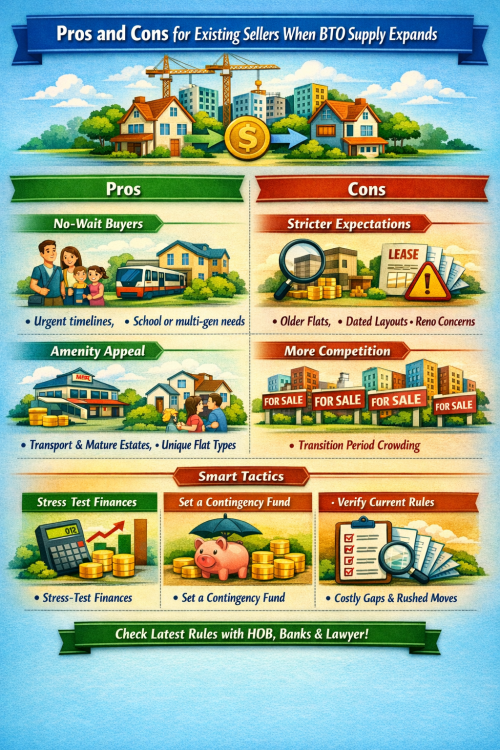
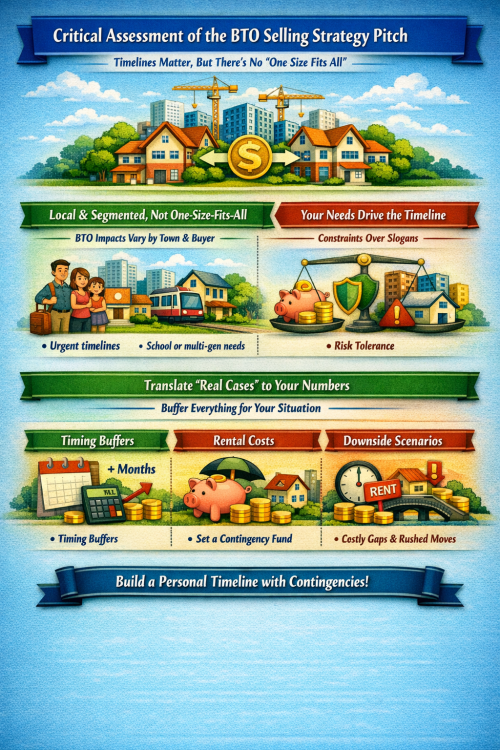
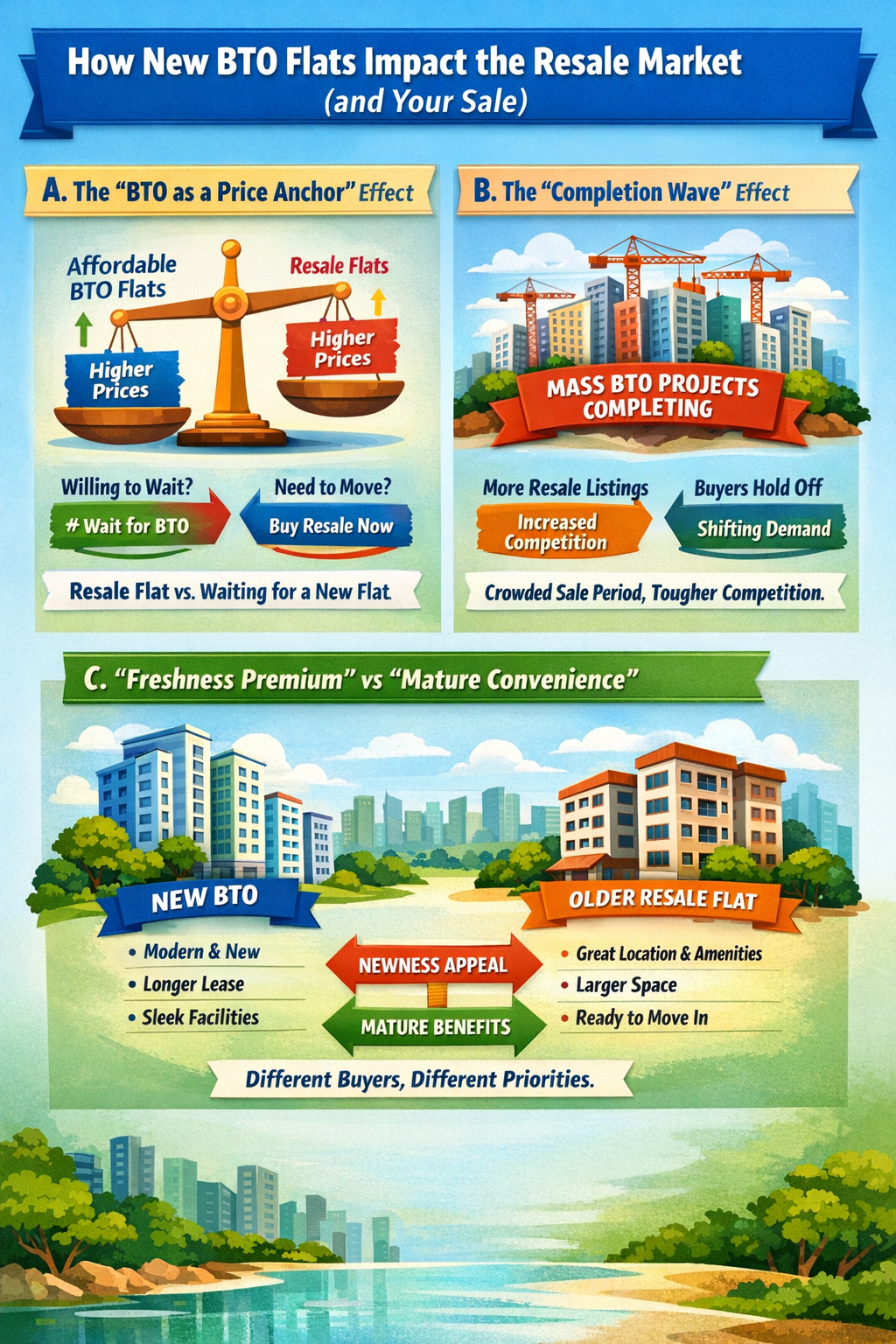
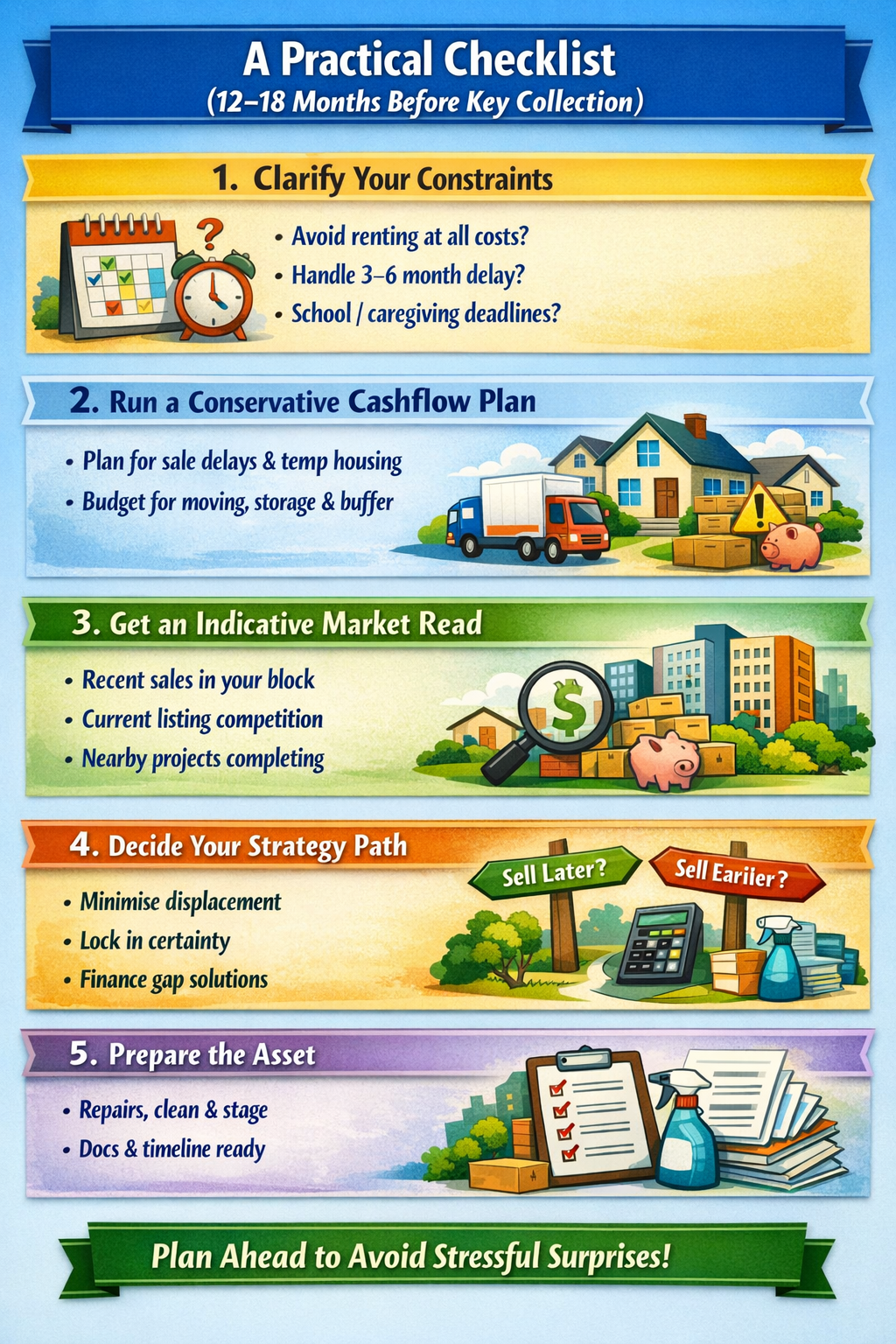
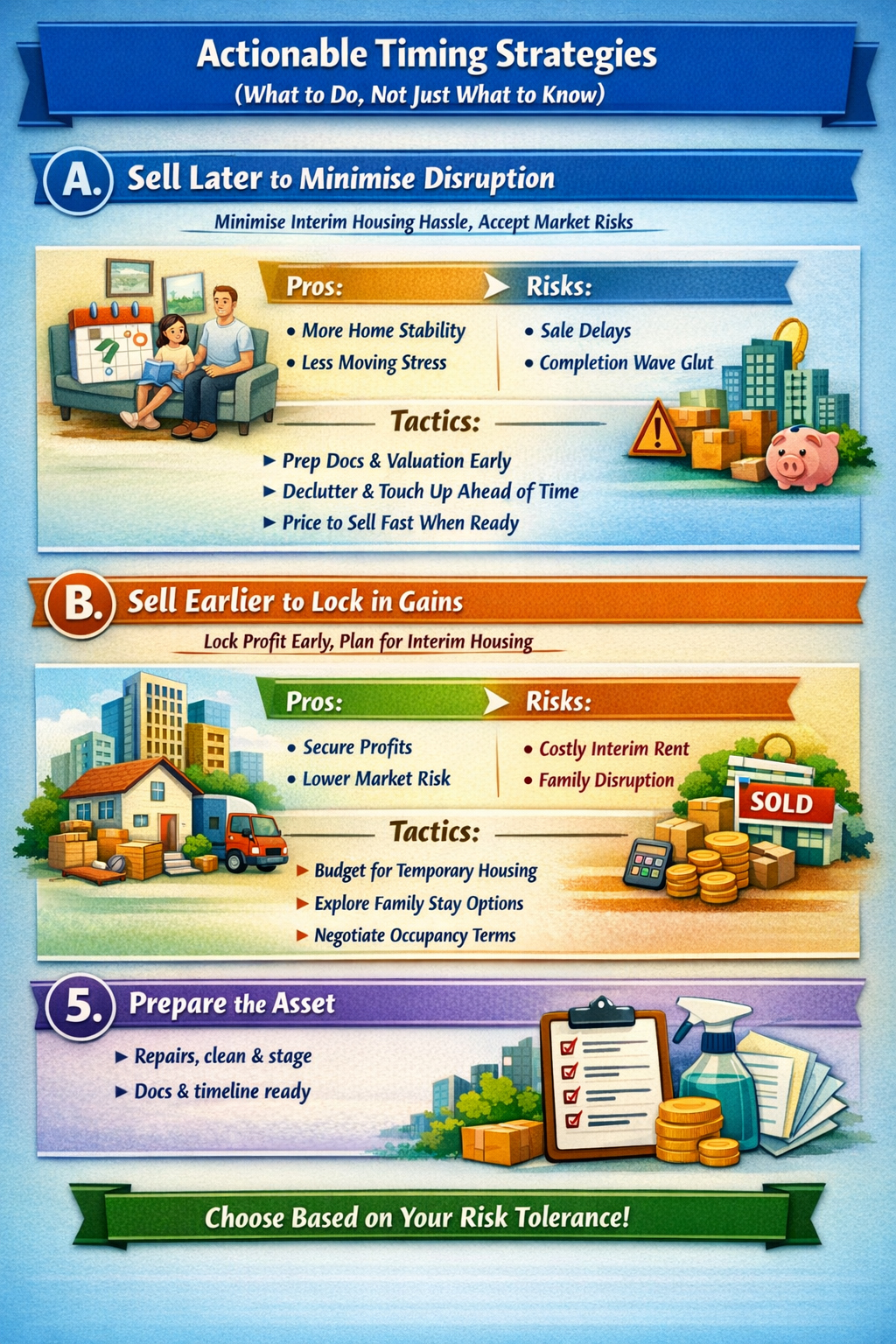
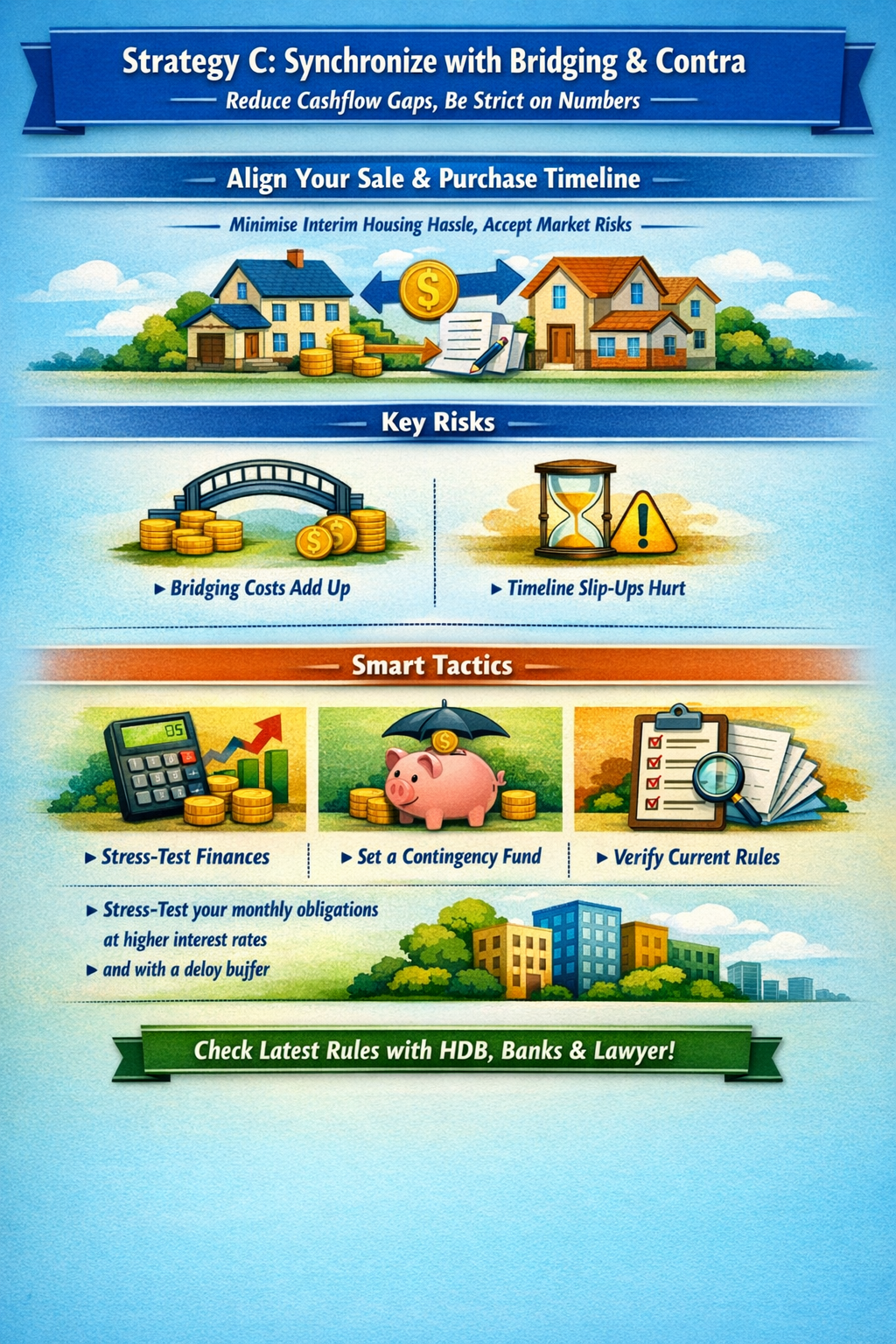
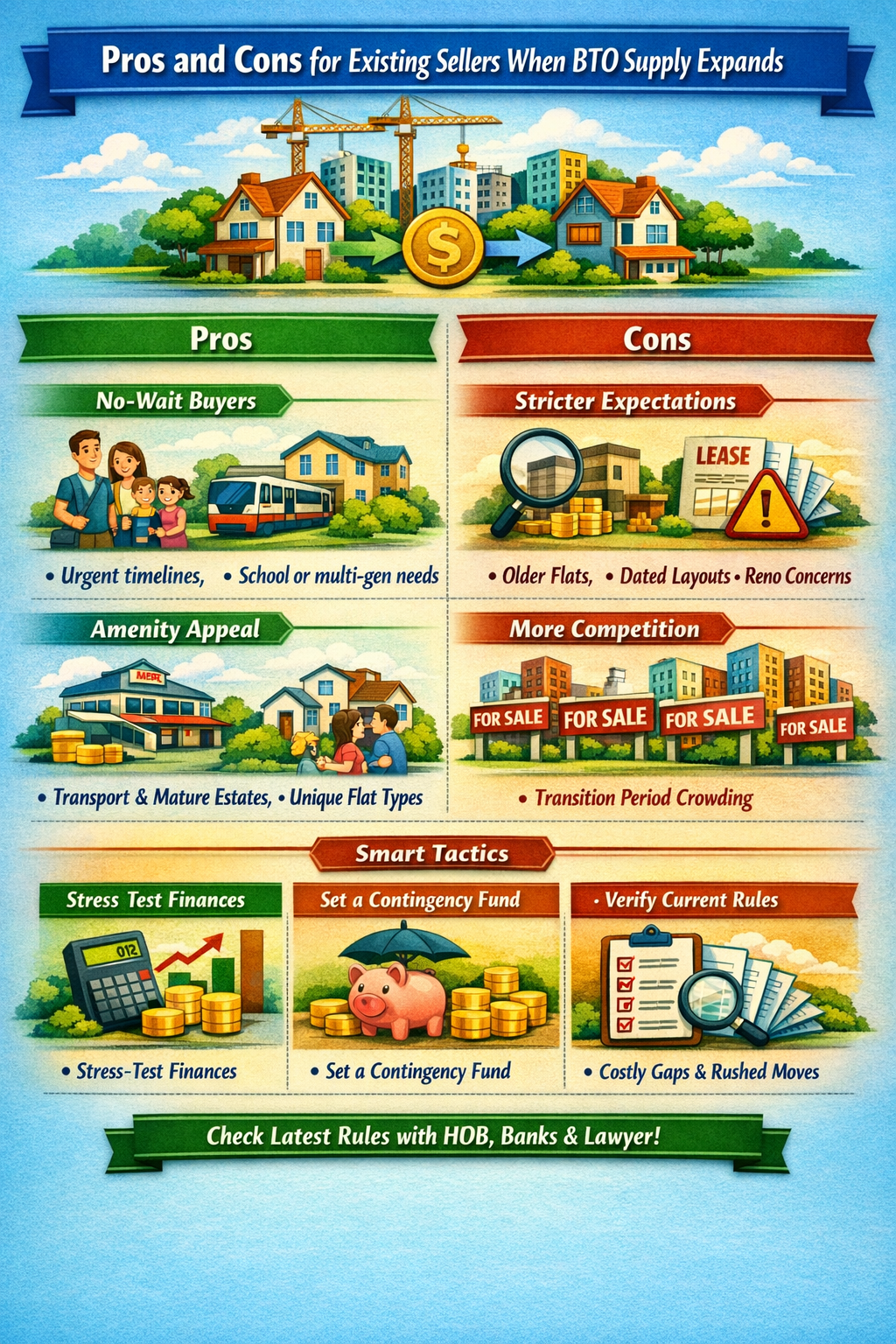
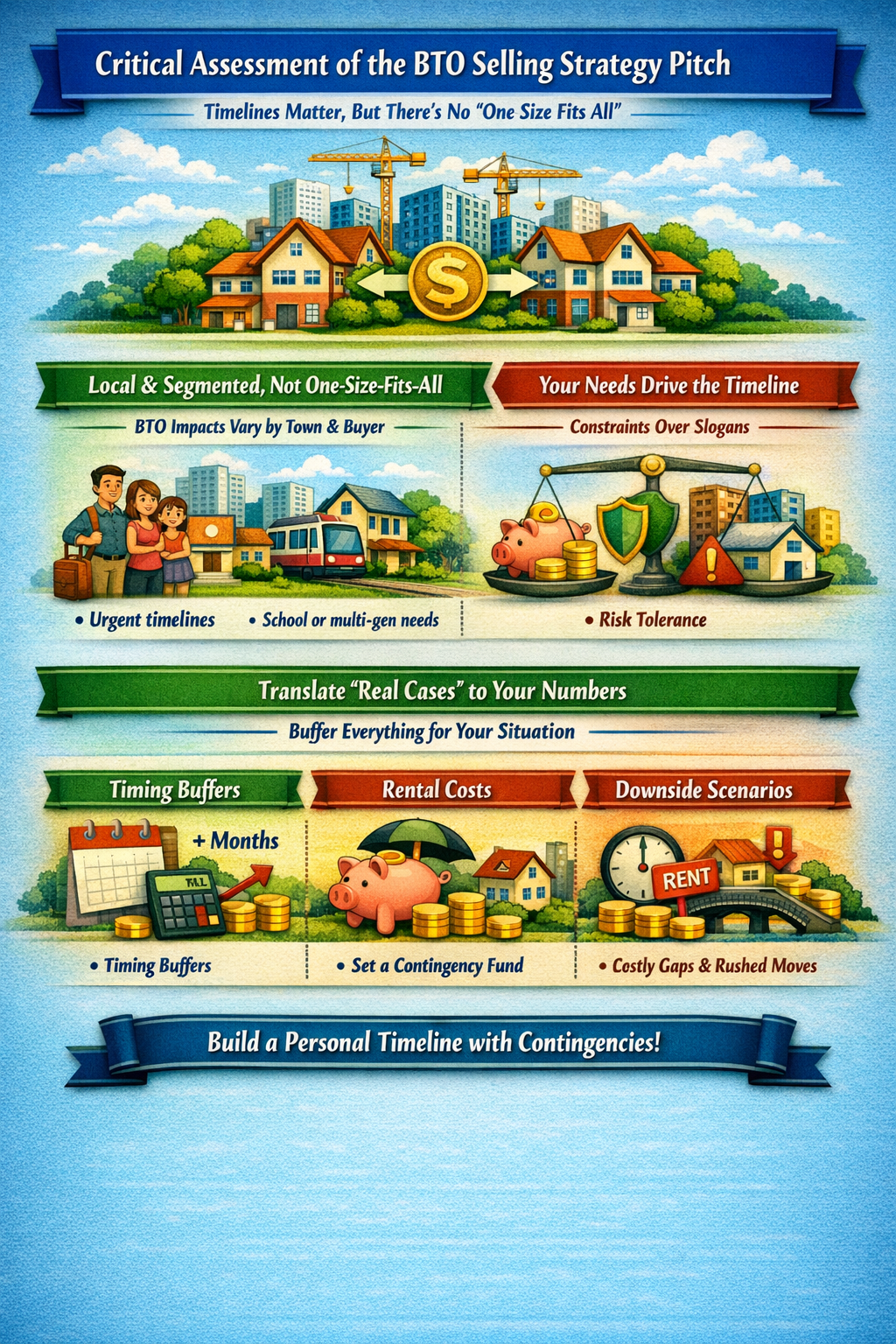
BTO Is Coming, So When Should You Sell? A critical look at how new Build-to-Order (BTO) flats affect resale values, plus actionable timing strategies, matters because many homeowners focus on headline prices and miss the moving parts that shape the final outcome. New BTO launches and completions can change what buyers compare your flat against, and that can influence viewing interest, how long your unit sits on the market, and how firm buyers are during negotiation. This is not about fear or hype. It is about understanding how supply, buyer expectations, and timing can interact so you can plan with fewer surprises. Some advertisements promise real timelines, avoid cashflow gaps, and plan your move without rushing or delay. Those are the right themes because the hardest part of upgrading (or right-sizing) around a BTO is not just the price you sell at or the price you pay. It is timing risk. You are trying to line up three things that rarely move in sync: (1) the sale of your existing flat, (2) your purchase process and the moment you collect the BTO keys, and (3) your household cashflow and housing needs in the period between. If your sale completes too early, you may need a temporary place to stay, store belongings, or manage higher short-term costs. If your sale completes too late, you may face pressure, limited flexibility, or a rushed decision that weakens your bargaining position. Even when the numbers look fine on paper, the stress often comes from these timing mismatches. Below is a professional, critical assessment of how new BTO launches and completions can influence the sale of existing units, followed by practical strategies you can actually execute. The goal is to help you think in a clear sequence, anticipate common pinch points, and make decisions based on realistic timing rather than best-case assumptions. With the right plan, you can reduce the chance of being forced into a poor deal, and you can move in a way that fits your budget, your schedule, and your family’s needs. How New BTO Flats Impact the Resale Market (and Your Sale) BTO flats can “anchor” resale prices because they are subsidised but require waiting, so buyers who can wait may limit what they’ll pay for resale, while buyers who need a home quickly still keep resale demand alive; resale competition also tends to spike when nearby BTO projects are nearing completion and many owners list their flats at the same time. For new launches, key red flags are thinking something is “cheap for the district” when it’s actually pricey for its exact micro-location, buying into areas with a large pipeline of similar projects completing in the same 1–3 year window (which increases substitutes and pressures resale and rents), and having weak holding power due to high maintenance fees, inefficient layouts, or relying heavily on long-term “transformation” stories that may be delayed or already priced in. Boutique condos can be attractive for privacy and low crowding, but because they have fewer transactions, pricing can be skewed by a small number of deals and resale can be less liquid, with greater price swings and higher dependence on micro-location value especially if better-value alternatives exist nearby. Pros and Cons for Existing Sellers When BTO Supply Expands Resale market The resale market can be resilient because it serves “no-wait” buyers who need to move quickly, want a specific school area, or need layouts that suit multi-generation living, so demand can hold up even when new BTO launches are available. Resale flats can also command an amenity premium, especially in mature estates, near transport nodes, or for rarer flat types that are hard to replicate in new supply, and activity may be supported by an upgrader chain when BTO owners get their keys and sell their current homes, keeping transactions flowing. On the downside, buyers can be more demanding when BTO is seen as better value, leading to tougher negotiations particularly for older flats with shorter leases, dated layouts, or heavier renovation needs—while periods with many simultaneous sellers can increase competition and weaken pricing power. There are also timing and cashflow risks: mismatched completion dates can force temporary rentals, bridging loans, or rushed decisions that reduce your net proceeds even if the headline sale price looks good. Actionable Timing Strategies (What to Do, Not Just What to Know) Strategy A: Sell Later: In general, the “sell later” strategy means holding your home longer to wait for better pricing (e.g., after nearby upgrades, market recovery, or hitting key milestones like MOP/SSD timelines) rather than rushing to sell. The main risks are that prices may stagnate or fall while you carry higher costs (mortgage interest, maintenance/MCST, taxes, repairs), your timeline can be derailed by job/family needs or loan changes, and competing listings/new launches can cap your upside. Tactics include choosing a clear trigger to sell (target price/date, policy milestones, completion of nearby catalysts), keeping the unit “sale-ready” with light upkeep, tracking competing supply and recent transactions, managing holding costs (refinance/reprice where possible), and having a backup plan (rent out, stagger the next purchase, or accept a realistic price range if conditions turn). Strategy B: Selling earlier to lock in gains means you cash out sooner so you can secure your profit and reduce the chance that a weaker market later affects your selling price. The trade-off is that you may need interim housing, which can be expensive, and it can cause disruption to the family (moving twice, temporary arrangements). To manage this, budget upfront for temporary housing, consider staying with family if possible, and negotiate occupancy terms (e.g., extension of stay after completion) to reduce the gap between selling and moving into your next home. Strategy C: Synchronise with bridging/contra to reduce cashflow gaps (but be strict on numbers) This approach is for households that must sell and buy quickly and want to avoid a long rental gap by aligning the sale and completion dates with the payment timeline of the next home, using tools like bridging finance if needed. The main risks are that bridging costs can add up and delays can cascade if you plan based on optimistic timelines, so you should stress-test your monthly cashflow at higher interest rates, build in a delay buffer, and keep a 3–6 month contingency fund for housing and moving costs, while confirming the latest rules and loan options with HDB, your bank, and your lawyer. If buyers are comparing your flat against a BTO, protect your resale price by highlighting what BTO can’t offer immediate move-in and certainty through strong “move-in ready” presentation, clear benefits like commute, schools and amenities, fixing obvious defects to reduce renovation doubts, preparing key facts (lease, upgrades, defect history), and pricing realistically against alternatives like other resales, waiting for BTO, or renting while they wait so the premium feels justified. A Practical Checklist (12–18 Months Before Key Collection) Start by clarifying your real constraints whether you must avoid renting, whether you can cope with a 3–6 month delay without major stress, and whether there are fixed deadlines such as school enrolment or caregiving needs. Next, build a conservative cashflow plan that assumes a worst-case timeline (your sale takes longer, your next home’s key collection shifts, and you may need temporary housing), and include all one-off costs like moving, storage, overlapping renovation expenses, and an emergency buffer. Then get a grounded sense of the market by checking recent transactions for the same block/stack, how much competition you face from current listings, and whether there’s significant new supply completing nearby. With that information, choose a strategy that fits your risk tolerance sell later to minimise disruption, sell earlier to lock in certainty, or try to synchronise timings using financing tools to reduce the gap (while accepting the added cost). Finally, prepare the home to sell well by doing small repairs, a deep clean and basic staging, and get your documents and timeline aligned early with your agent and conveyancing lawyer. Critical Assessment of the BTO Selling Strategy Pitch The ad is right that you should focus on timelines, cashflow gaps, and planning calmly instead of rushing, but you should be wary of anyone claiming there is one “best” timing formula. BTO effects aren’t the same everywhere they vary by town and by the type of buyers in your area so the best time for you to sell depends on your own constraints like your finances, risk tolerance, and housing needs. “Real case studies” are only useful if you convert them into your own numbers, such as how many buffer months you can afford, what renting would cost, and what happens if things go wrong. A good guide or advisor should help you build a personalised plan with backup options, not just tell you to “sell at the perfect moment.”


-
Other Related Property Articles: SG Property Article 1: The 3 Certainties of Property Transformation: A Professional Framework for Timing Your Entry https://www.geomancy.net/forums/topic/20897-the-3-main-signs-of-property-change-when-to-step-in-and-buy/ SG Property Article 2: A practical pro and cons review of how Singapore poperty is often assessed and sometimes marketed by real estate agents https://www.geomancy.net/forums/topic/20898-a-practical-pro-and-cons-review-of-how-singapore-property-is-often-assessed-and-sometimes-marketed-by-real-estate-agents/ SG Property Article 3: Boutique condos in Singapore are often ignored https://www.geomancy.net/forums/topic/20904-boutique-condos-in-singapore-are-often-ignored-because-most-buyers-focus-on-big-high-unit-projects-but-they-can-offer-strong-long-term-value/ SG Property Article 4: BTO is coming, so when should you sell? https://www.geomancy.net/forums/topic/20903-bto-is-coming-so-when-should-you-sell/ SG Property Article 5: A buyer playbook using MAPS Investment screening process https://www.geomancy.net/forums/topic/20900-a-buyer-playbook-using-maps-investment-screening-process/ SG Property Article 7: Your HDB Is Your Starting Point https://www.geomancy.net/forums/topic/20908-sg-property-article-7-your-hdb-is-your-starting-point/ SG Property Article 8: Reckless housing land bids? https://www.geomancy.net/forums/topic/20912-sg-property-article-8-reckless-housing-land-bids/ SG Property Article 9: HDB resale prices post first decline in nearly seven years https://www.geomancy.net/forums/topic/20919-sg-property-article-9-hdb-resale-prices-post-first-decline-in-nearly-seven-years/ SG Property Article 10: Ten Reasons why HDB Homeowners sell their flats https://www.geomancy.net/forums/topic/20942-sg-property-article-10-why-hdb-homeowners-sell-their-flats-and-what-it-says-about-life-in-singapore/ SG Property Article 11: Educational Infographic Ads Designed to Boost Engagement https://www.geomancy.net/forums/topic/20962-sg-property-article-11-educational-infographic-ads-designed-to-boost-engagement/ SG Property Article 12: A critical review of the common unit selection framework https://www.geomancy.net/forums/topic/20899-a-critical-review-of-the-common-unit-selection-framework-made-popular-by-singapore-property-influencers-and-agents/ SG Property Article 13: Condo owners may lose their apartment for owing maintenance charges https://www.geomancy.net/forums/topic/20952-condo-owners-may-lose-their-apartment-for-owing-maintenance-charges/ SG Property Article 14: HDB Lease Decay - By 2030, close to 500,000 HDB flats will be older than 40 years https://www.geomancy.net/forums/topic/20969-sg-property-article-14-hdb-lease-decay-by-2030-close-to-500000-hdb-flats-will-be-older-than-40-years/ SG Property Article 15: Failed “99-1” ownership scheme leads to costly lawsuit, highlighting stricter IRAS scrutiny and risks of trying to bypass Singapore’s ABSD https://www.geomancy.net/forums/topic/20878-sg-property-article-15-failed-99-1-ownership-scheme-leads-to-costly-lawsuit-highlighting-stricter-iras-scrutiny-and-risks-of-trying-to-bypass-singapores-absd/ SG Property Article 16: Star Buy Units in New Launch Condos: What They Really Mean + 5-Factor Checklist to Spot a Genuine Deal https://www.geomancy.net/forums/topic/20994-sg-property-article-16-star-buy-units-in-new-launch-condos-what-they-really-mean-5-factor-checklist-to-spot-a-genuine-deal/


-
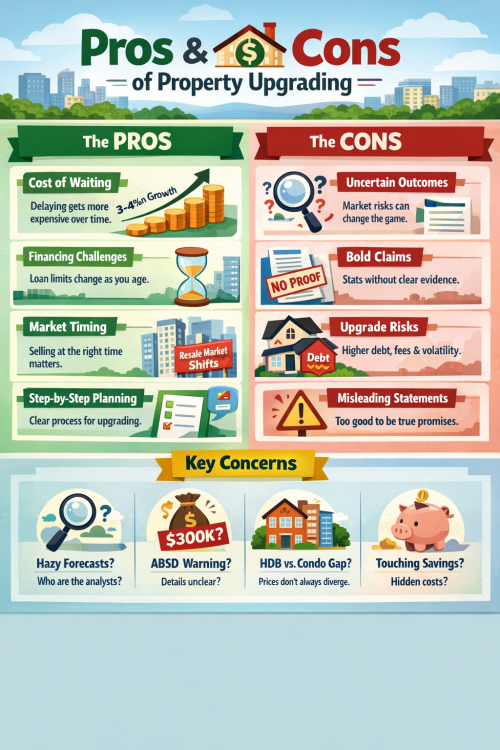
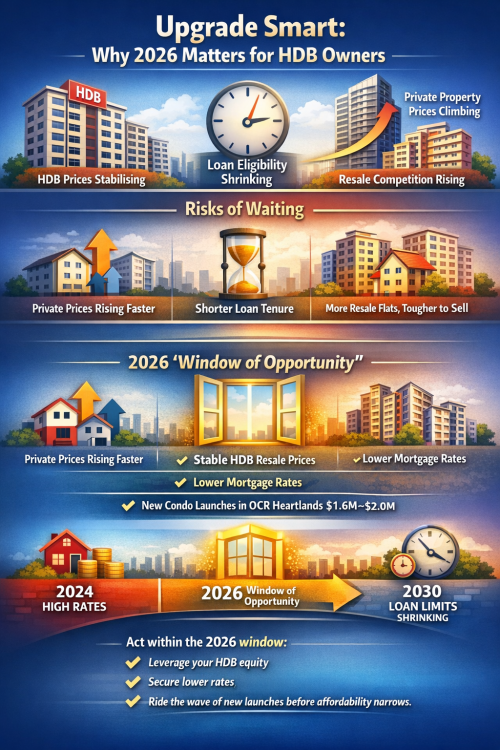
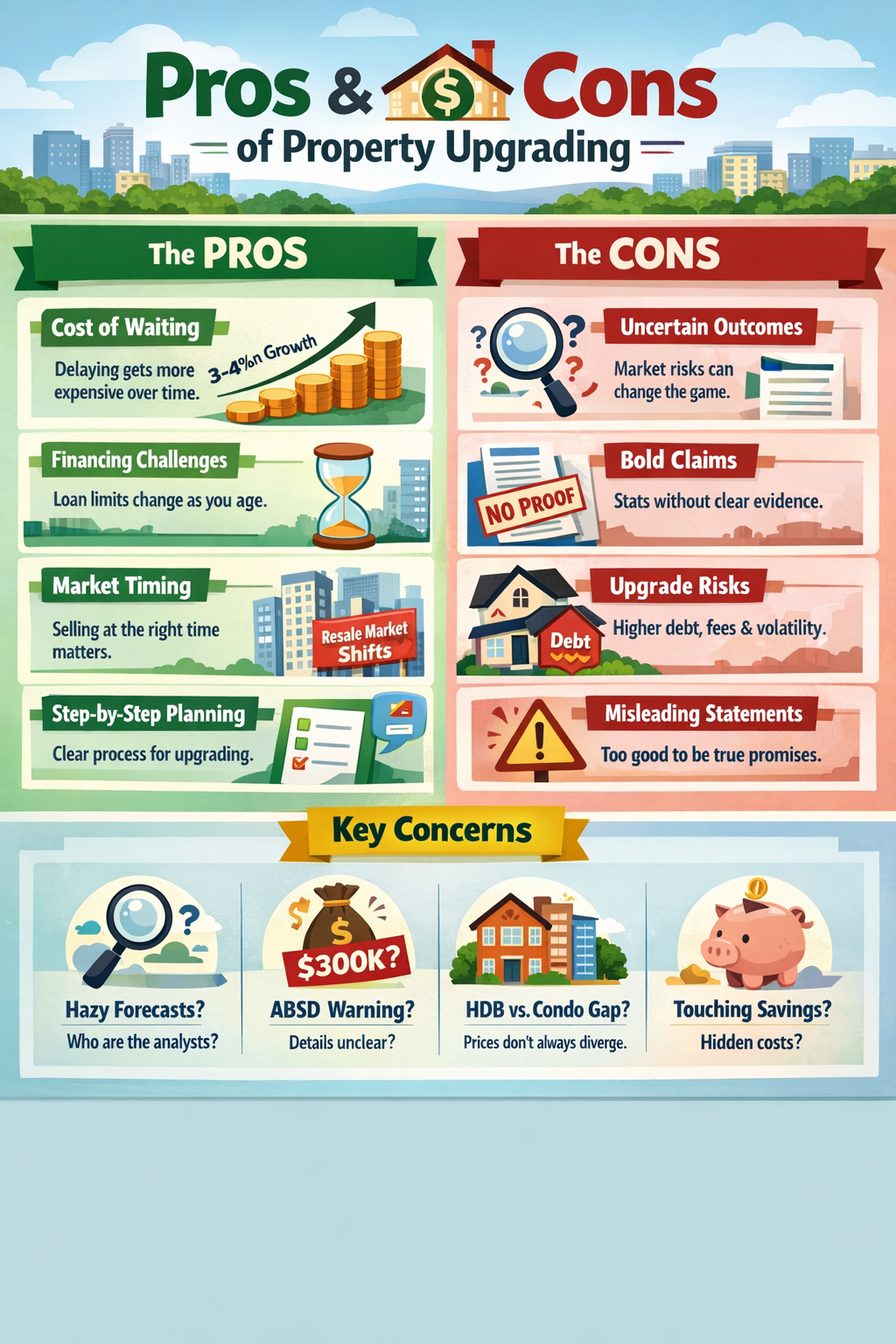
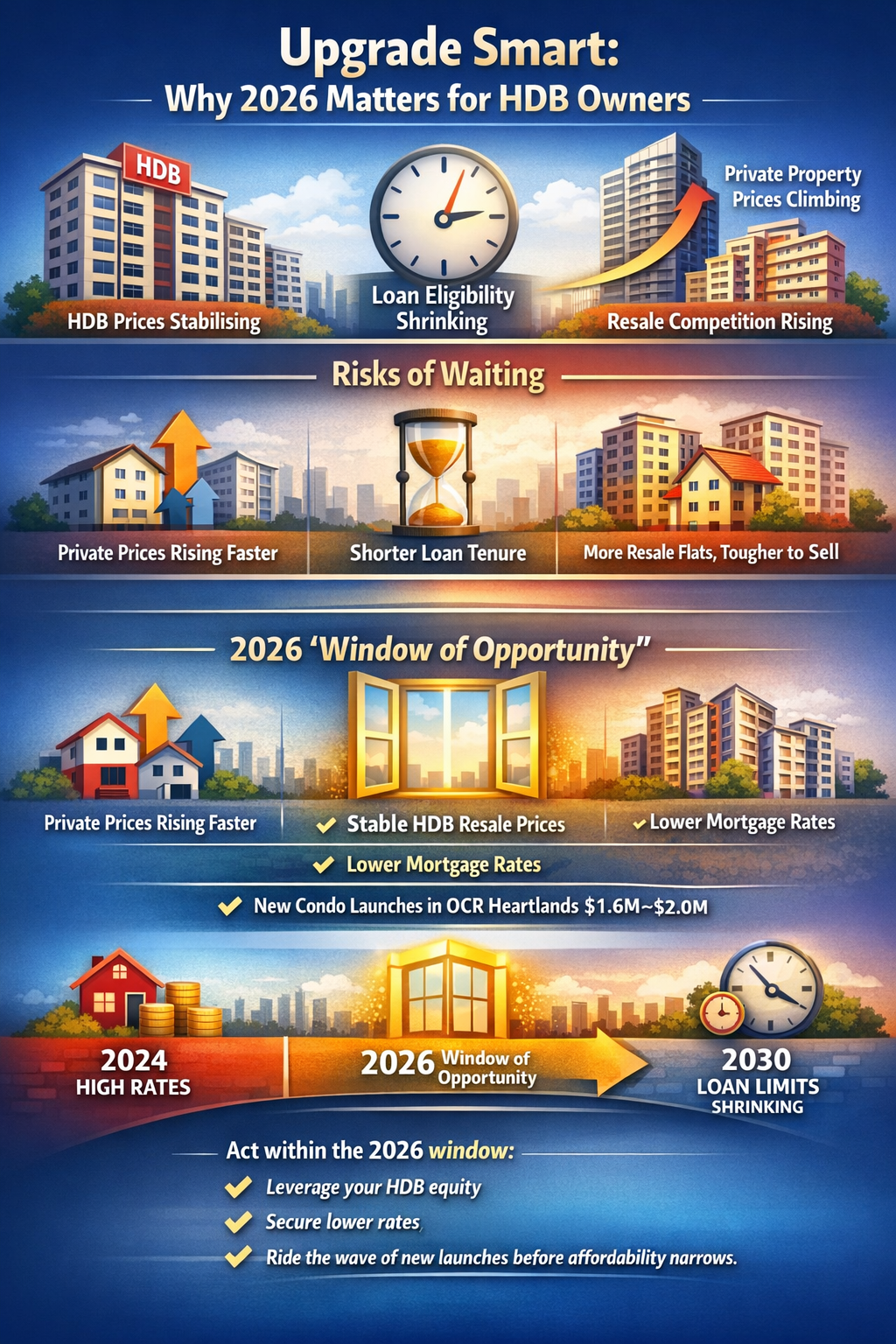
A recent article that I had read was about a practical guide for Singapore HDB owners who want to upgrade to private property without depleting personal savings, by using the equity built in their flat and planning the move correctly. It warns that waiting can be costly because private home prices may continue to outpace HDB values, loan eligibility can shrink with age (shorter tenures and higher monthly repayments), and a larger wave of resale flats entering the market could increase competition for sellers. The guide highlights 2026 as a potential “window” for upgraders, driven by three converging factors: (1) HDB resale prices stabilising near recent highs, (2) lower mortgage rates compared to 2024 peaks, and (3) a concentration of new condo launches in OCR heartland areas where many upgraders live—often with three-bedroom options around $1.6M–$2.0M. A core takeaway is that upgrading can be structured using HDB sale proceeds and refunded CPF OA to fund the down-payment potentially requiring no cash from personal savings, depending on individual numbers. It also explains how to avoid the ABSD trap (which can be substantial) by sequencing the transaction correctly most commonly by selling the HDB first before buying the condo and provides a clear five-step action plan to execute the upgrade with confidence. What the article is claiming? The guide argues that many HDB owners who “wait” to upgrade are taking on a hidden financial risk: private home prices may keep rising faster than their HDB resale value, loan eligibility typically tightens with age (shorter tenure → higher monthly repayment), and a 2026 influx of Minimum Occupation Period (MOP) flats may increase resale competition—so acting earlier can improve both buying and selling outcomes. It positions 2026 as a “market window” and hints there is a major ABSD pitfall that can cost upgraders a large sum. Pros (what’s strong, useful, or directionally correct)Highlights real opportunity cost and compounding. If the target private property price rises 3–4% annually, delaying can materially increase the required budget; compounding makes “one more year” decisions expensive over time. Correctly flags that financing constraints change with age. Shorter loan tenures (driven by age-based limits) can raise monthly payments and reduce affordability even if income is unchanged—this is a legitimate planning constraint for upgraders. Calls attention to market timing on the sell side, not just the buy side. Increased resale supply (e.g., many MOP flats entering the market) can weaken a seller’s negotiating power and price outcomes. Communicates in a practical, step-by-step framing. It sets expectations that upgrading is a process with financial and structural steps, which can help households plan rather than “hope” for the perfect time. Cons / gaps (where the reasoning may be incomplete or biased)One-sided framing (“waiting is the riskiest move”) overstates certainty. Property outcomes are path-dependent: price growth, interest rates, job stability, and policy changes can flip the calculus. The guide largely frames waiting as uniformly harmful without showing scenarios where waiting is rational (e.g., high interest rates, weak income visibility, family needs). Key quantitative claims are not evidenced in the excerpt. The “13,400 MOP flats in 2026” statistic and “almost double” comparison are asserted without a cited source, methodology, or geographic breakdown (nationwide supply does not affect all towns equally). The “analyst forecast” of 3–4% private appreciation is presented as conservative, but the guide doesn’t name the analysts, timeframe, or whether this applies to all segments (OCR/RCR/CCR; new launch vs resale). Assumes the HDB–condo gap necessarily widens. The guide states your HDB “didn’t grow at the same rate” as private property, implying a persistent divergence. That can be true at times, but not universally—HDB resale cycles can outperform in certain periods/locations, and private prices can stagnate or correct. Downplays the risks of upgrading. Upgrading adds exposure to: higher debt, interest-rate volatility, maintenance/MCST fees (for condos), vacancy risk (if renting), renovation costs, and potential price drawdowns. These are not acknowledged in the excerpt even though they materially affect “without touching savings” narratives. “Upgrade without touching savings” can be misleading without context. It may be achievable via sale proceeds, CPF usage, bridging loans, or higher leverage—but each comes with constraints (TDSR/MSR, CPF refund rules, cash buffers, interest-rate stress). The excerpt doesn’t define what “savings” means or the assumptions required. ABSD warning is attention-grabbing but underspecified here. The claim that an “ABSD mistake” can cost $300,000 might be true for certain price points and ABSD rates, but without explaining the scenario (e.g., buying second property before selling, eligibility/remission rules, timelines), readers can’t evaluate applicability. Marketing-adjacent positioning despite disclaimers. The text says it’s “not a sales pitch” and invites readers to contact an advisor who shared the guide. That doesn’t invalidate the content, but it does raise incentive concerns: the narrative emphasizes urgency and action, which can bias advice toward transacting. Critical takeaways (how to use this responsibly)Treat the guide as a prompt to run your numbers, not as proof that upgrading is always optimal. The strongest decision-relevant ideas here are: (1) financing constraints with age, (2) opportunity cost of price growth, and (3) sell-side competition from supply changes—but each needs to be validated for your flat, target segment, and risk tolerance. Missing from the excerpt (but essential): interest-rate sensitivity, downside scenarios, transaction costs (BSD/ABSD/legal/agent/reno), and what happens if either market (HDB or private) underperforms.
-
Hello Master Lee! I am referred by [Mrs hidden] and [M.. hidden]. I would like to seek your advice for my new 5 room BTO house.

-
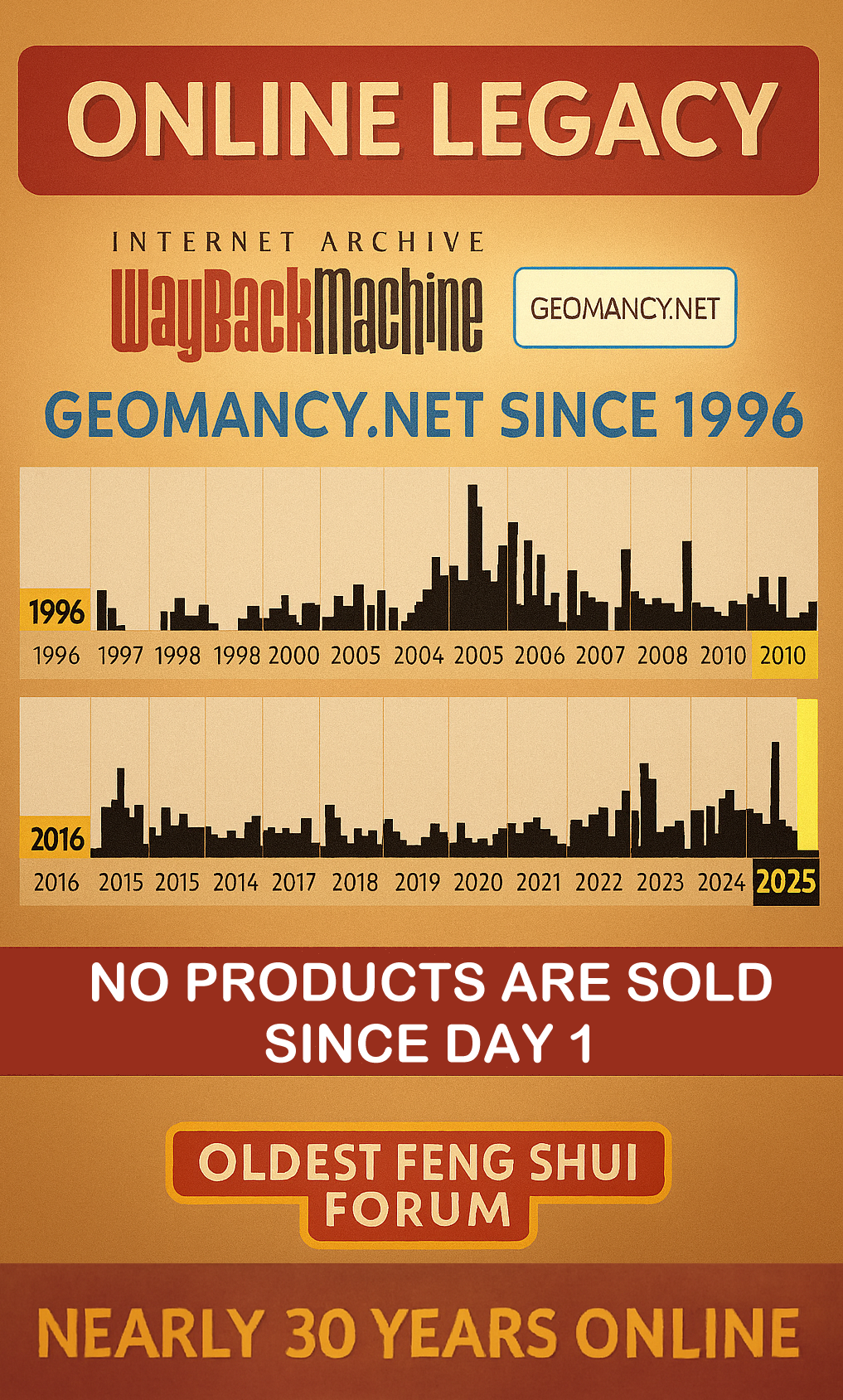
Discover the World’s Oldest Feng Shui Forum (C) Geomancy.net Geomancy.net holds the distinction of being the oldest Feng Shui forum globally, serving as a significant platform for discussions and insights related to this ancient practice. Its longevity underscores its importance as a Leader in the field of Feng Shui. How can we help you today? GET EXPERT HELP: IMPROVE YOUR HEALTH, WEALTH & HAPPINESS TODAY Comprehensive Home Package [A.]: On-site or [B.]: Off-site for HDB / Condo / EC & Landed Properties for New/Re-Sale House or facing financial/ marriage/ relationship/ health issues Do you offer a 1 visit On-site audit? How much? " As much as we see, Geomancy.net has great web presence built up over the years and is seen as one of the SG market leaders in residential house audit. " Transparent Pricing & No Hidden Costs. No Purchase of Products. Cecil Lee, +65 9785-3171 / support@geomancy.net House Hunting? We will help you select the most auspicious unit! Learn More The Experts in House Hunting AUSPICIOUS DATES FOR ONE OR TWO PERSONS Please visit 30 Days Auspicious Date for ONE or TWO Person(s) - FengShui.Geomancy.Net +++ Related: Non-Religious Chinese Customs For New Re-Sale Home +++ Geomancy.net e-books https://www.geomancy.net/forums/store/category/1-geomancynet-e-books/ +++ ALL ELSE FANNING CALM & LET CECIL HANDLE IT








-
Katong Antique House with placement of a pair of sugar cane during CNY







-
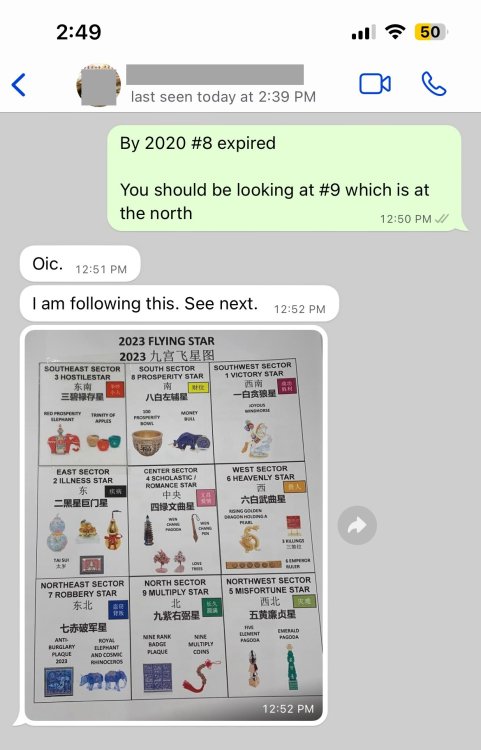
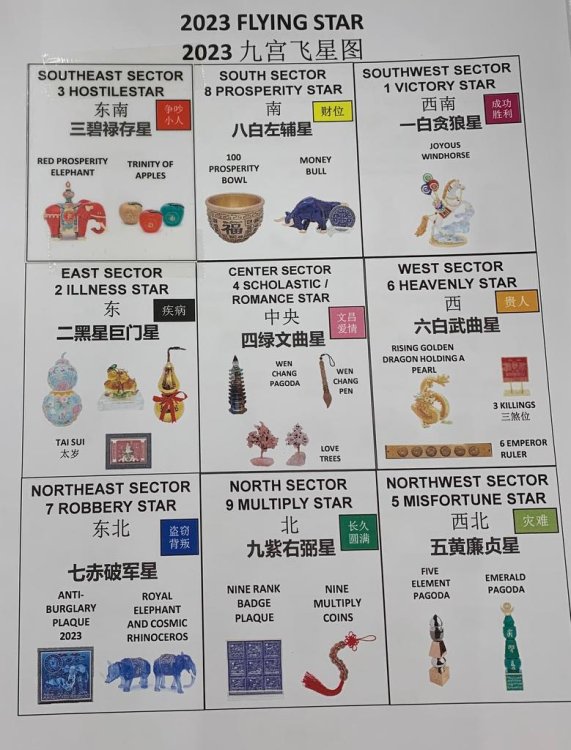
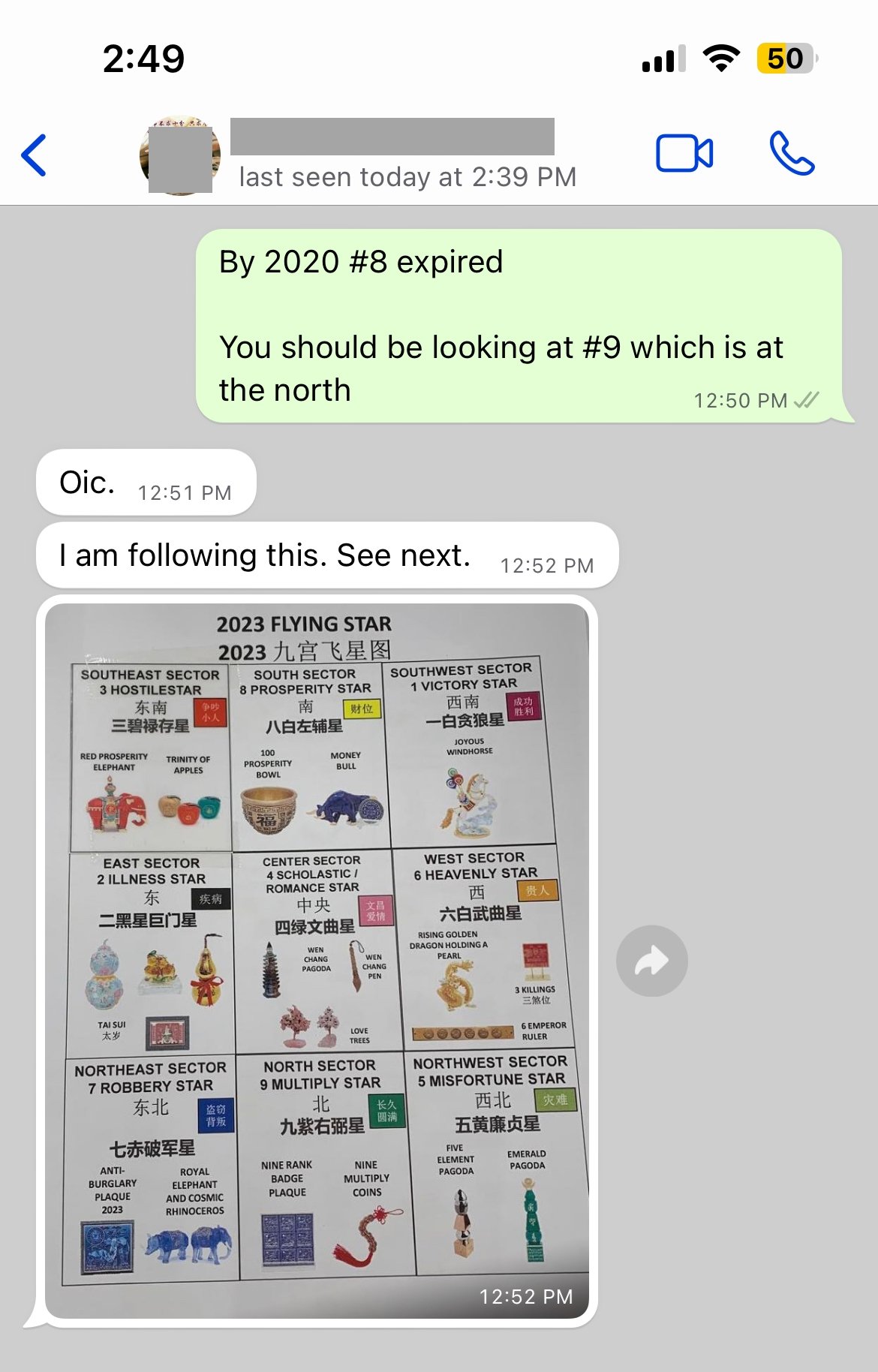
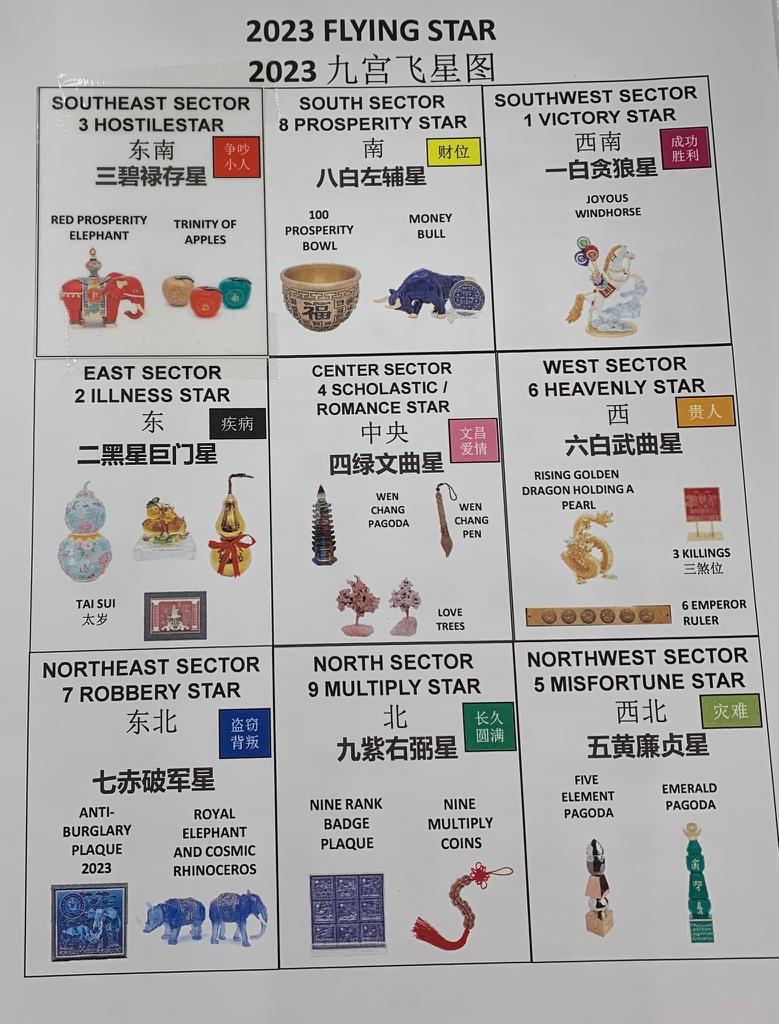
The truth about annual Feng Shui products: what’s sold as tradition has become a highly profitable buying trap. What many people don’t realize: annual Feng Shui products are less about balance and more about selling fear. Annual Feng Shui products aren’t guidance they’re a carefully engineered sales cycle. Let’s call it what it is: the annual Feng Shui buying cycle has become a commercialized scam. Understanding the Commercial Side of Modern Feng Shui The Annual Feng Shui Money Trap: Why You’re Told to Buy for All Nine Sectors Every Year The Feng Shui Sales Machine: How Annual “Cures” Turn Advice into Retail Annual Feng Shui Products Explained: Nine Sectors, Endless Purchases Separating Authentic Feng Shui from Product-Driven Practices Feng Shui Without Forced Buying: What Clients Are Rarely Told Many Feng Shui shops deliberately push customers to buy new items year after year, making it seem like these purchases are unavoidable. The bigger the family, the more objects we’re told we need, filling our homes with products we never truly needed in the first place. Over time, this becomes a repeating cycle—almost like an addiction—where people feel they have to make an annual pilgrimage to these so‑called Feng Shui masters. Fear, superstition, and guilt are quietly used to pressure people into buying again and again. In the end, the real purpose becomes clear: generating super‑normal profits for the sellers, while ordinary people unknowingly become their victims. Recognizing this pattern is the first step toward breaking free from it. Behind the friendly advice lies a clear motive: to push customers into buying as many products as possible—one for each of the nine sectors of their home. This isn’t guidance; it’s systematic upselling disguised as tradition. If we want this cycle to end, it starts with us. Please spread the word: when people stop buying out of fear, the selling stops too.



-
Other Related Property Articles: SG Property Article 1: The 3 Certainties of Property Transformation: A Professional Framework for Timing Your Entry https://www.geomancy.net/forums/topic/20897-the-3-main-signs-of-property-change-when-to-step-in-and-buy/ SG Property Article 2: A practical pro and cons review of how Singapore poperty is often assessed and sometimes marketed by real estate agents https://www.geomancy.net/forums/topic/20898-a-practical-pro-and-cons-review-of-how-singapore-property-is-often-assessed-and-sometimes-marketed-by-real-estate-agents/ SG Property Article 3: Boutique condos in Singapore are often ignored https://www.geomancy.net/forums/topic/20904-boutique-condos-in-singapore-are-often-ignored-because-most-buyers-focus-on-big-high-unit-projects-but-they-can-offer-strong-long-term-value/ SG Property Article 4: BTO is coming, so when should you sell? https://www.geomancy.net/forums/topic/20903-bto-is-coming-so-when-should-you-sell/ SG Property Article 6: Why 2026 matters for HDB owners who want to upgrade https://www.geomancy.net/forums/topic/20902-why-2026-matters-for-hdb-owners-who-want-to-upgrade-to-private-property-without-depleting-personal-savings/ SG Property Article 7: Your HDB Is Your Starting Point https://www.geomancy.net/forums/topic/20908-sg-property-article-7-your-hdb-is-your-starting-point/ SG Property Article 8: Reckless housing land bids? https://www.geomancy.net/forums/topic/20912-sg-property-article-8-reckless-housing-land-bids/ SG Property Article 9: HDB resale prices post first decline in nearly seven years https://www.geomancy.net/forums/topic/20919-sg-property-article-9-hdb-resale-prices-post-first-decline-in-nearly-seven-years/ SG Property Article 10:Ten Reasons why HDB Homeowners sell their flats https://www.geomancy.net/forums/topic/20942-sg-property-article-10-why-hdb-homeowners-sell-their-flats-and-what-it-says-about-life-in-singapore/ SG Property Article 11: Educational Infographic Ads Designed to Boost Engagement https://www.geomancy.net/forums/topic/20962-sg-property-article-11-educational-infographic-ads-designed-to-boost-engagement/ SG Property Article 12: A critical review of the common unit selection framework https://www.geomancy.net/forums/topic/20899-a-critical-review-of-the-common-unit-selection-framework-made-popular-by-singapore-property-influencers-and-agents/ SG Property Article 13: Condo owners may lose their apartment for owing maintenance charges https://www.geomancy.net/forums/topic/20952-condo-owners-may-lose-their-apartment-for-owing-maintenance-charges/ SG Property Article 14: HDB Lease Decay - By 2030, close to 500,000 HDB flats will be older than 40 years https://www.geomancy.net/forums/topic/20969-sg-property-article-14-hdb-lease-decay-by-2030-close-to-500000-hdb-flats-will-be-older-than-40-years/ SG Property Article 15: Failed “99-1” ownership scheme leads to costly lawsuit, highlighting stricter IRAS scrutiny and risks of trying to bypass Singapore’s ABSD https://www.geomancy.net/forums/topic/20878-sg-property-article-15-failed-99-1-ownership-scheme-leads-to-costly-lawsuit-highlighting-stricter-iras-scrutiny-and-risks-of-trying-to-bypass-singapores-absd/ SG Property Article 16: Star Buy Units in New Launch Condos: What They Really Mean + 5-Factor Checklist to Spot a Genuine Deal https://www.geomancy.net/forums/topic/20994-sg-property-article-16-star-buy-units-in-new-launch-condos-what-they-really-mean-5-factor-checklist-to-spot-a-genuine-deal/


-
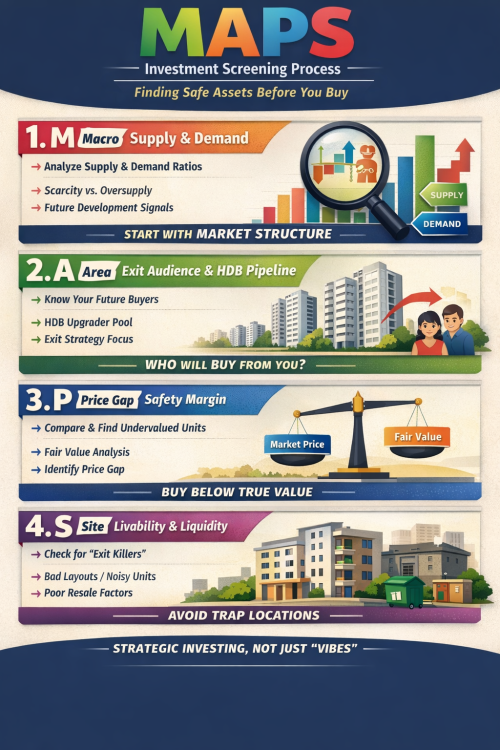
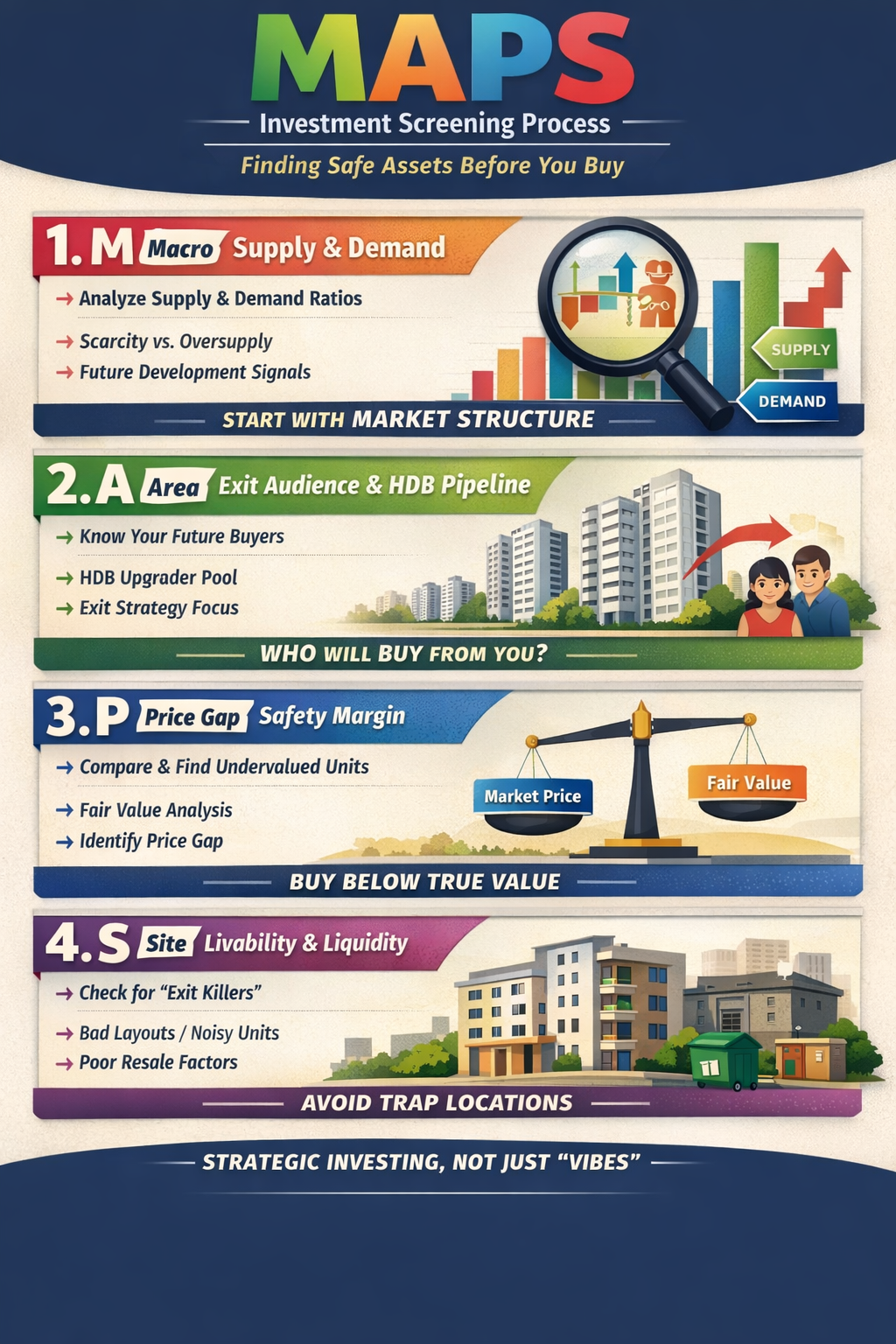
A critical review of a Buyer Playbook I read—what it gets right and where it oversells. The document/flyer is a tightly packaged pitch for a DIY buyer philosophy (“Homevestment”) anchored by a simple decision stack (“4-Step MAPS”). Its core strength is forcing buyers to stop shopping with vibes (views, shiny fittings, high-floor myths) and start evaluating exitability, liquidity, and entry price discipline. It frames property less as a dream object and more as a resaleable asset useful medicine in overheated markets. That said, it reads like a sales funnel disguised as a framework: bold outcomes (“strong growth,” “avoid losing money over 5 years”) are asserted more than demonstrated, case studies are selectively persuasive, and the method omits several real-world variables that can dominate outcomes. Sharp observations (the good) The deck’s best idea is to “think about your exit first”: buy with your future buyer in mind, because resale value depends on who will want (and be able) to pay for the home later, not just what you personally like now. It usefully highlights four common ways buyers get stuck bad overall market dynamics, weak location demand, overpaying versus comparable options, and unit/project features that turn buyers off and it correctly stresses that paying the right entry price (with proper comparisons for things like tenure, MRT distance, layout and floor) is a major driver of outcomes. It also warns against overpaying for “ego features” like very high floors if the next buyer is price-sensitive. Where it falls short is implying the framework is close to a guarantee: real results still depend heavily on interest rates, financing rules, policy changes, and project-specific issues. It also defines “macro” too narrowly (not enough focus on credit conditions and affordability), treats “area demand” too much as one buyer type (like HDB upgraders), makes price comparison sound easier than it really is (many hidden factors can distort “fair value”), understates the practical complexity of doing a purchase without experienced help, and while its “exit killers” list is good, it misses other common deal-breakers like noise, pollution, awkward unit design, weak building finances/maintenance, and years of nearby construction disruption. Verdict: MAPS is a solid teaching scaffold especially the emphasis on exitability and price discipline but the document oversells certainty, underspecifies the hardest analytical step (normalization), and leaves out major risk variables that determine whether “homevestment” behaves like investment or like expensive consumption. A simplified, more readable article: The Homevestment Method and the 4-Step MAPS Framework The Homevestment idea Homevestment means treating a home like an investment asset: instead of choosing based on what you personally love right now, you focus on what many future buyers will want and, importantly, what they will be able to afford. It shifts your decision-making from emotion-first to resale-first by prioritising two ideas: first, that “liquidity” matters an ideal home is one that can be resold easily to a wide pool of buyers at a fair price; and second, that most returns are made at the point of purchase if you overpay upfront, you may spend years trying to overcome that high entry price. The 4-Step MAPS Framework is presented as the method for putting this Homevestment approach into practice. The 4-Step MAPS Framework (Macro → Area → Price Gap → Site) The 4-Step MAPS Framework is a way to choose a property based on resale strength rather than hype. Macro means you don’t buy a “good story” about an area you check the real demand-versus-supply conditions, whether transactions are consistently happening, whether new future supply could swamp prices, and whether affordability and financing conditions support buyers (because property moves with credit). Area means you decide who your future resale buyer is before picking a location, and then confirm the area can reliably “replenish” that buyer pool through things like demographics, jobs, schools, transport access, and policy factors, instead of depending on one fragile narrative. Price Gap is the main risk-control step: you compare the asking price to several true substitutes, adjust for key differences (like MRT walk time, layout, floor, and noise/heat), estimate a fair-value range, and only buy if you’re meaningfully below it so you don’t overpay. Site is about avoiding unit or project features that turn buyers off at resale things like inefficient layouts, west sun, facing bin centres or substations, cramped rooms, or tiny projects with low transaction volume because if a flaw makes a large share of buyers hesitate, it weakens demand and gives buyers leverage to negotiate your price down. Benefits of using MAPS (per the document’s intent) This approach helps you buy more rationally by replacing “gut feel” and marketing claims with a clear, objective checklist to screen properties. It improves downside protection by emphasising the “Price Gap” or margin of safety aiming to buy with a real buffer rather than paying a merely “fair” or inflated price. It also keeps resale in mind by making you define your future buyer upfront (your exit audience) and avoid features that shrink your buyer pool or make the home harder to sell (“exit killers”), which supports better liquidity. Because the steps are structured (Macro, Area, Price Gap, Site), it becomes a repeatable process you can apply consistently and use to buy with more confidence. Finally, it reinforces that “best” doesn’t always mean “most expensive” a lower entry price can sometimes deliver a better outcome if it gives you a bigger safety margin, such as choosing value over paying extra for a high floor.


-
Other Related Property Articles: SG Property Article 1: The 3 Certainties of Property Transformation: A Professional Framework for Timing Your Entry https://www.geomancy.net/forums/topic/20897-the-3-main-signs-of-property-change-when-to-step-in-and-buy/ SG Property Article 3: Boutique condos in Singapore are often ignored https://www.geomancy.net/forums/topic/20904-boutique-condos-in-singapore-are-often-ignored-because-most-buyers-focus-on-big-high-unit-projects-but-they-can-offer-strong-long-term-value/ SG Property Article 4: BTO is coming, so when should you sell? https://www.geomancy.net/forums/topic/20903-bto-is-coming-so-when-should-you-sell/ SG Property Article 5: A buyer playbook using MAPS Investment screening process https://www.geomancy.net/forums/topic/20900-a-buyer-playbook-using-maps-investment-screening-process/ SG Property Article 6: Why 2026 matters for HDB owners who want to upgrade https://www.geomancy.net/forums/topic/20902-why-2026-matters-for-hdb-owners-who-want-to-upgrade-to-private-property-without-depleting-personal-savings/ SG Property Article 7: Your HDB Is Your Starting Point https://www.geomancy.net/forums/topic/20908-sg-property-article-7-your-hdb-is-your-starting-point/ SG Property Article 8: Reckless housing land bids? https://www.geomancy.net/forums/topic/20912-sg-property-article-8-reckless-housing-land-bids/ SG Property Article 9: HDB resale prices post first decline in nearly seven years https://www.geomancy.net/forums/topic/20919-sg-property-article-9-hdb-resale-prices-post-first-decline-in-nearly-seven-years/ SG Property Article 10: Ten Reasons why HDB Homeowners sell their flats https://www.geomancy.net/forums/topic/20942-sg-property-article-10-why-hdb-homeowners-sell-their-flats-and-what-it-says-about-life-in-singapore/ SG Property Article 11: Educational Infographic Ads Designed to Boost Engagement https://www.geomancy.net/forums/topic/20962-sg-property-article-11-educational-infographic-ads-designed-to-boost-engagement/ SG Property Article 12: A critical review of the common unit selection framework https://www.geomancy.net/forums/topic/20899-a-critical-review-of-the-common-unit-selection-framework-made-popular-by-singapore-property-influencers-and-agents/ SG Property Article 13: Condo owners may lose their apartment for owing maintenance charges https://www.geomancy.net/forums/topic/20952-condo-owners-may-lose-their-apartment-for-owing-maintenance-charges/ SG Property Article 14: HDB Lease Decay - By 2030, close to 500,000 HDB flats will be older than 40 years https://www.geomancy.net/forums/topic/20969-sg-property-article-14-hdb-lease-decay-by-2030-close-to-500000-hdb-flats-will-be-older-than-40-years/ SG Property Article 15: Failed “99-1” ownership scheme leads to costly lawsuit, highlighting stricter IRAS scrutiny and risks of trying to bypass Singapore’s ABSD https://www.geomancy.net/forums/topic/20878-sg-property-article-15-failed-99-1-ownership-scheme-leads-to-costly-lawsuit-highlighting-stricter-iras-scrutiny-and-risks-of-trying-to-bypass-singapores-absd/ SG Property Article 16: Star Buy Units in New Launch Condos: What They Really Mean + 5-Factor Checklist to Spot a Genuine Deal https://www.geomancy.net/forums/topic/20994-sg-property-article-16-star-buy-units-in-new-launch-condos-what-they-really-mean-5-factor-checklist-to-spot-a-genuine-deal/ Since 1996 (C) Geomancy.net

.thumb.png.eae7b38dd4ed6ce01b23be2b51da5e63.png)
-
Other Related Property Articles: SG Property Article 1: The 3 Certainties of Property Transformation: A Professional Framework for Timing Your Entry https://www.geomancy.net/forums/topic/20897-the-3-main-signs-of-property-change-when-to-step-in-and-buy/ SG Property Article 2: A practical pro and cons review of how Singapore poperty is often assessed and sometimes marketed by real estate agents https://www.geomancy.net/forums/topic/20898-a-practical-pro-and-cons-review-of-how-singapore-property-is-often-assessed-and-sometimes-marketed-by-real-estate-agents/ SG Property Article 3: Boutique condos in Singapore are often ignored https://www.geomancy.net/forums/topic/20904-boutique-condos-in-singapore-are-often-ignored-because-most-buyers-focus-on-big-high-unit-projects-but-they-can-offer-strong-long-term-value/ SG Property Article 4: BTO is coming, so when should you sell? https://www.geomancy.net/forums/topic/20903-bto-is-coming-so-when-should-you-sell/ SG Property Article 5: A buyer playbook using MAPS Investment screening process https://www.geomancy.net/forums/topic/20900-a-buyer-playbook-using-maps-investment-screening-process/ SG Property Article 6: Why 2026 matters for HDB owners who want to upgrade https://www.geomancy.net/forums/topic/20902-why-2026-matters-for-hdb-owners-who-want-to-upgrade-to-private-property-without-depleting-personal-savings/ SG Property Article 7: Your HDB Is Your Starting Point https://www.geomancy.net/forums/topic/20908-sg-property-article-7-your-hdb-is-your-starting-point/ SG Property Article 8: Reckless housing land bids? https://www.geomancy.net/forums/topic/20912-sg-property-article-8-reckless-housing-land-bids/ SG Property Article 9: HDB resale prices post first decline in nearly seven years https://www.geomancy.net/forums/topic/20919-sg-property-article-9-hdb-resale-prices-post-first-decline-in-nearly-seven-years/ SG Property Article 10: Ten Reasons why HDB Homeowners sell their flats https://www.geomancy.net/forums/topic/20942-sg-property-article-10-why-hdb-homeowners-sell-their-flats-and-what-it-says-about-life-in-singapore/ SG Property Article 11: Educational Infographic Ads Designed to Boost Engagement https://www.geomancy.net/forums/topic/20962-sg-property-article-11-educational-infographic-ads-designed-to-boost-engagement/ SG Property Article 13: Condo owners may lose their apartment for owing maintenance charges https://www.geomancy.net/forums/topic/20952-condo-owners-may-lose-their-apartment-for-owing-maintenance-charges/ SG Property Article 14: HDB Lease Decay - By 2030, close to 500,000 HDB flats will be older than 40 years https://www.geomancy.net/forums/topic/20969-sg-property-article-14-hdb-lease-decay-by-2030-close-to-500000-hdb-flats-will-be-older-than-40-years/ SG Property Article 15: Failed “99-1” ownership scheme leads to costly lawsuit, highlighting stricter IRAS scrutiny and risks of trying to bypass Singapore’s ABSD https://www.geomancy.net/forums/topic/20878-sg-property-article-15-failed-99-1-ownership-scheme-leads-to-costly-lawsuit-highlighting-stricter-iras-scrutiny-and-risks-of-trying-to-bypass-singapores-absd/ SG Property Article 16: Star Buy Units in New Launch Condos: What They Really Mean + 5-Factor Checklist to Spot a Genuine Deal https://www.geomancy.net/forums/topic/20994-sg-property-article-16-star-buy-units-in-new-launch-condos-what-they-really-mean-5-factor-checklist-to-spot-a-genuine-deal/ Since 1996 (C) Geomancy.net


-
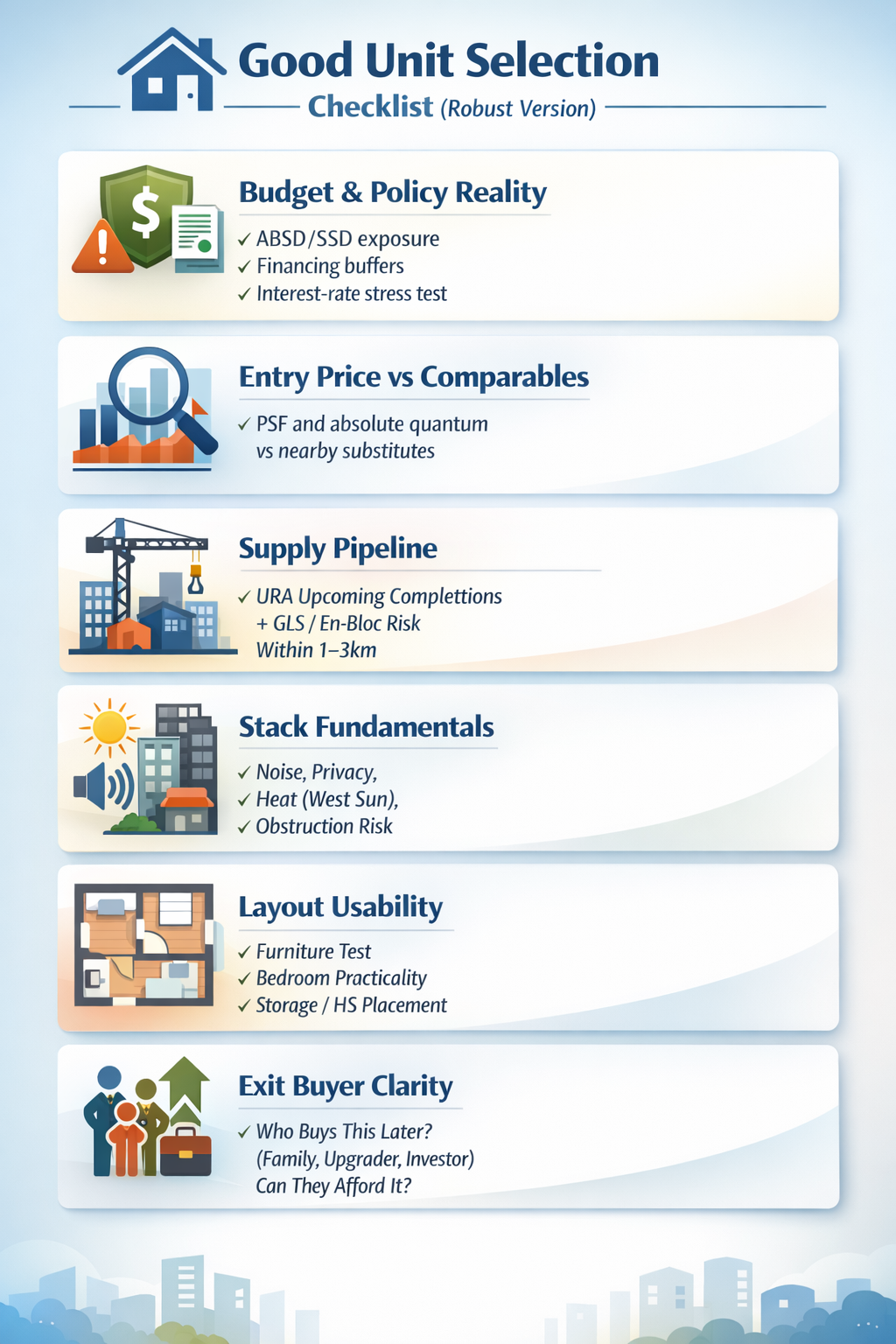
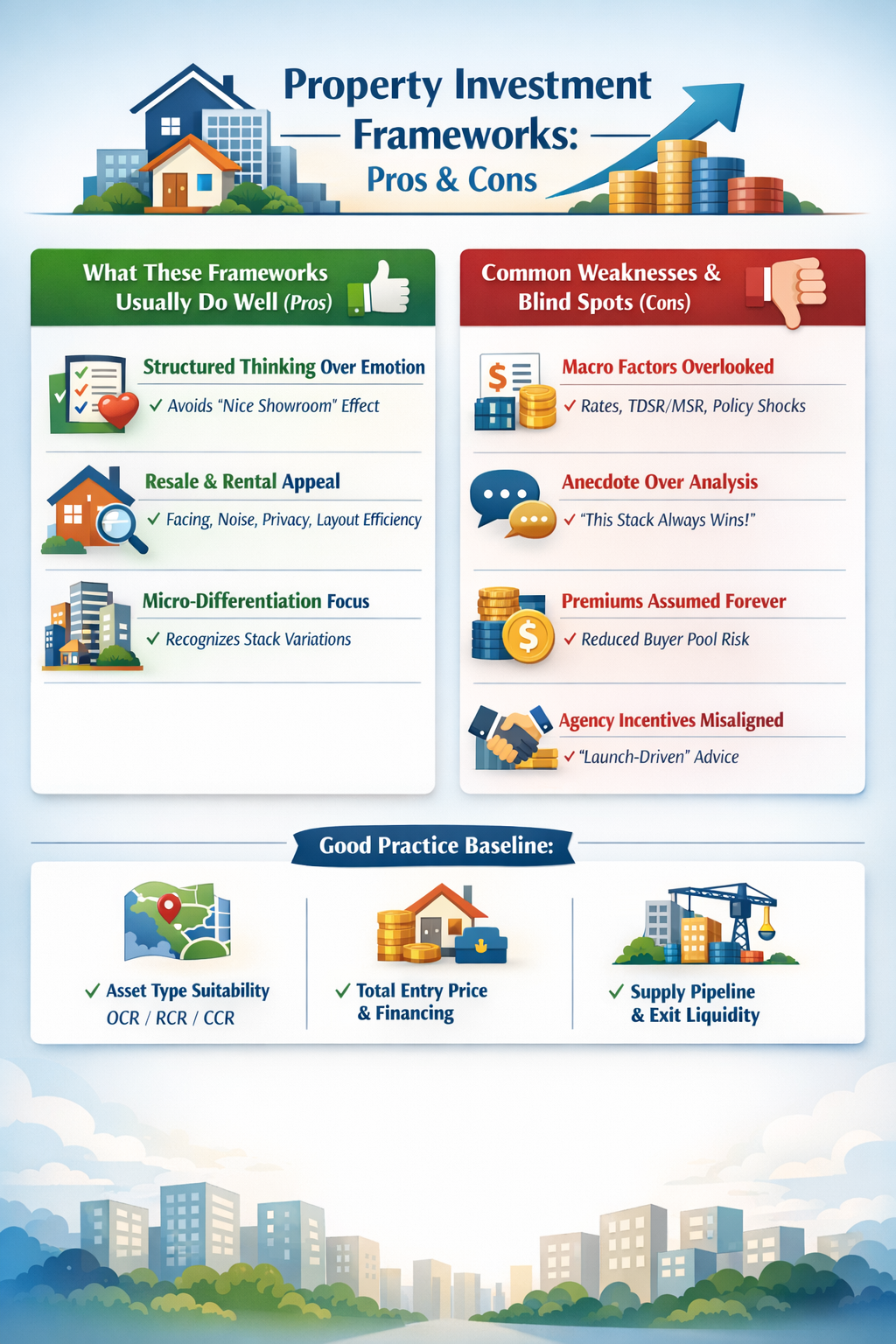
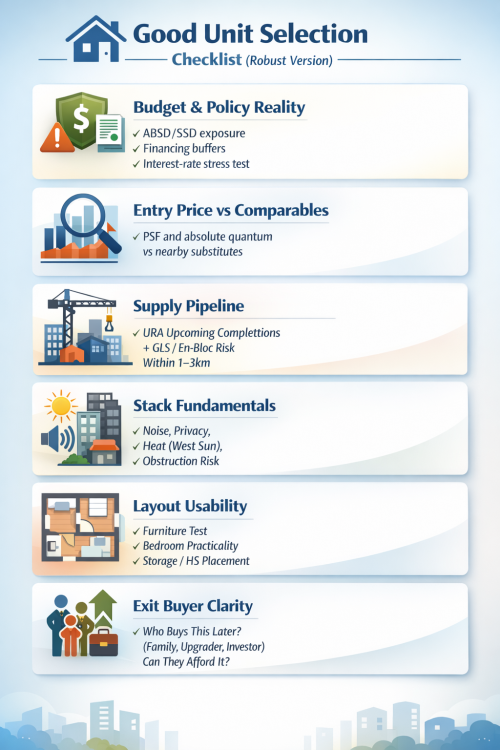
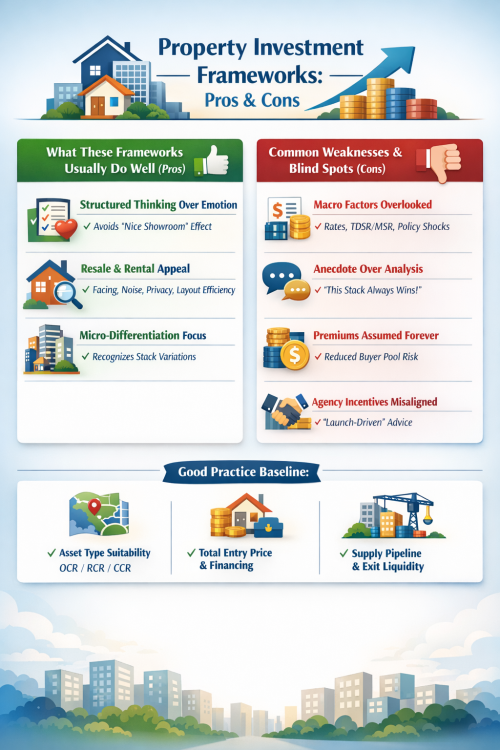
Introduction A critical review of the typical “unit selection framework” popularised by Singapore property influencers/agents (stack selection, facing/floor premiums, launch timing, and exit strategy). I’m not reviewing any one named person but I’ll flag where these frameworks are strong, where they can mislead, and what good practice due diligence looks like in Singapore’s context (ABSD/SSD, URA pipeline, new launch pricing behaviour, etc.). A. The framework itself — what it gets right and what it often misses What these frameworks usually do well (Pros) - Forces structured thinking instead of buying emotionally (“nice showroom” effect). - Translates “homebuyer preferences” into resale liquidity: facing, noise, privacy, layout efficiency do affect buyer pool and rental appeal. - Recognises micro-differentiation in condos where stacks can trade very differently even in the same project. Common weaknesses / blind spots (Cons) - Overweights micro factors (facing/floor) and underweights macro drivers: interest rates, credit rules (TDSR/MSR), policy shocks (ABSD changes), and nearby supply. - Uses selective anecdotes (“this stack always wins”) rather than transaction-level evidence and comparable analysis. - Assumes premiums always come back: paying extra for “best stack” can reduce your future buyer pool (fewer people can afford it) and compress upside. - Agency incentive mismatch: some advice is subtly optimised for “closing at launch” rather than maximising risk-adjusted returns. - Undervalues holding power & cashflow: the best unit on paper can still be a bad buy if your financing, ABSD exposure, or rental buffer is weak. Good practice baseline: treat unit selection as secondary to (1) asset type suitability (OCR/RCR/CCR, freehold/99), (2) total entry price & financing resilience, (3) supply pipeline and exit liquidity. --- 1) Entry Price (Facings | Floor Level) How the “popular discussion” usually frames it - Choose “premium” facings (unblocked, pool view, greenery, away from road/bin centre/substation). - Higher floors = better (view, wind, privacy). - Pay a premium if it’s “rare” because resale buyers will pay too. What’s valid (Pros) - Noise and negative adjacencies are real in Singapore (major roads, MRT tracks, expressways, schools, places of worship, bin centre, loading bay, substation). - Privacy/unblocked view has measurable resale impact, especially for mass-market condos where stacks compete tightly. - Floor premium is usually real up to a point, especially where view corridors matter. Where it goes wrong (Cons / pitfalls) - Premium stacking can become “overpaying”: if you pay a big premium at launch, your resale upside may be capped because future buyers benchmark against nearby alternatives and their affordability ceiling. - High floor isn’t always superior: - Wind, heat, lift reliance, maintenance issues, and “too high” can be less preferred by some families. - “Unblocked” can be temporary if you didn’t verify zoning / future plots. - Facing myths: “south-facing is best” is too simplistic; what matters is afternoon west sun, cross-ventilation, and your specific obstruction/noise context. Good practices (Singapore-specific) - Quantify the premium: compare stack/floor premiums within the same project and against nearby resale/new launches by PSF and absolute price. - Check future obstruction risk using URA Master Plan / zoning and nearby GLS sites, not just current greenery. - Do “negative adjacency mapping”: locate bin centre, guardhouse, function room, tennis court, pools, pump rooms, substation, MSCP ramps—these matter more than many people think. - Benchmark affordability: the best unit is the one your future buyer can still afford. Absolute quantum often constrains demand more than PSF. --- 2) Layout Typical influencer take - “Efficient layout wins” (minimise corridors/bay windows). - Dumbbell layouts for privacy; squarish living/dining; good bedroom sizes. - Avoid weird angles; avoid too much balcony. What’s valid (Pros) - Efficiency drives liveability and valuation: buyers pay for usable area. - Bedroom sizes and storage matter a lot in modern smaller units. - Functional kitchens (enclosed vs open) affect family demand and rental profile. Where it’s often oversimplified (Cons) - “Efficiency” is not universal: some segments value balcony/outdoor space; others want enclosed kitchens due to cooking habits. - Ignoring structural constraints: a “nice-looking plan” can be hard to renovate if many walls are structural, beams intrude, or AC ledge placement is awkward. - Not matching layout to target exit buyer: e.g., dual-key or small 2BR might rent well but have narrower resale demand depending on location/price point. Good practices - Measure real usability: - Can you place a proper sofa/TV wall and dining table without awkward circulation? - Are bedrooms genuinely fit for a queen bed + side tables? - Is there a household shelter (HS) and where is it placed (dead space vs storage)? - Match layout to your exit market: - Near business parks/MRT: compact 1–2BR can be liquid for tenants/investors. - Family-oriented node: 3BR with good bedroom sizes often more resilient. - Avoid “headline traps”: huge balcony counted in strata, long corridors, excessive planter/bay window-like dead spaces (less common now but still appears). --- 3) Demand and Supply Typical discussion - “Near MRT/schools = strong demand.” - “Low supply in the area = price support.” - “Look for transformation stories” (URA plans, new lines, commercial hubs). What’s valid (Pros) - Rental demand is location-led in Singapore (MRT connectivity, employment nodes). - Supply pipeline is crucial because condos compete against nearby substitutes. - Transformation catalysts can work, but only if they convert into real household formation and affordability. Where it can be misleading (Cons) - Demand is not just “interest”; it’s qualified demand (after ABSD/TDSR/MSR and interest rate reality). - Supply analysis is often shallow: people cite “few condos nearby” but ignore: - upcoming GLS sites, - en-bloc potential, - large EC/condo clusters completing around the same period, - unit mix competition (e.g., too many similar 2BRs). - Over-indexing on schools: within 1km matters mainly for certain primary schools and for certain buyer profiles; it may not offset an over-entry price. Good practices (data-driven) - Use URA pipeline and completion schedules (nearby projects TOP-ing within your expected exit window). - Study unit mix supply: if the district is flooded with small 2BRs, your 2BR faces heavier resale competition than a scarce 3BR type (or vice versa). - Check real rental comparables: not just asking rents—look at achieved rents (where possible) and vacancy sensitivity. --- 4) Timing Of Sales (when to buy) Typical influencer playbook - Buy early at launch for “lowest price.” - Look for “star buy” units. - Avoid later phases when developer raises prices. What’s true (Pros) - Developers do often price-in phases based on take-up. - Early phases may offer better unit choice and sometimes better pricing (not guaranteed). - “Star buy” can be real value if it’s not a compromised stack. Key risks and misconceptions (Cons) - Early is not automatically cheaper: some launches are priced aggressively from day 1 due to competition, land price, and recent comparables. - Showflat-driven urgency can cause mispricing decisions. - Macro timing matters more than launch phase: interest rate regime, policy risk, and broader affordability cycle often dominate. Good practices - Anchor to resale comparables: if new launch PSF is far above nearby resale without a strong reason (tenure, MRT proximity, scarcity, product leap), be cautious. - Watch absorption rate and price revisions: strong take-up can justify pricing; weak take-up may bring incentives (but Singapore incentives can be opaque—sometimes via commissions, rebates, or “discounted stacks”). - Consider your holding horizon: if you might need to sell within 3–4 years, you are much more exposed to cycle and SSD constraints. --- 5) How To Time The Exit Typical discussion - Sell at/after TOP when project “matures.” - Sell when nearby new launch pricing sets a higher benchmark. - Avoid SSD period; sell when demand is strong. What’s valid (Pros) - SSD is a real constraint and shapes optimal minimum holding periods for private property. - New launch pricing can “pull up” resale benchmarks—sometimes. - Project maturity (livability + transaction history) can widen buyer confidence. Where it’s often incomplete (Cons) - Exit is constrained by your buyer’s financing: even if your unit is “worth” more, buyers may not clear TDSR or may balk at quantum. - “TOP pop” isn’t guaranteed: if many units TOP together (area-wide supply wave), resale competition and rental vacancy can suppress prices. - Ignoring opportunity cost: sometimes the best exit is not “max price” but “best risk-adjusted redeployment,” especially under policy uncertainty or changing family needs. Good practices (practical exit planning) - Pre-plan an exit window (e.g., after SSD, or 1–2 years post-TOP) but validate against: - nearby completions (competition), - interest rate outlook (affects affordability), - your unit’s quantum bracket (mass-market vs high-end behave differently). - Track listing competition within your own project: if many identical stacks are listed, you need price realism. - Maintain optionality: choose units with stronger rental resilience so you can hold longer if the resale market is weak. --- A simple “good unit selection” checklist 1) Budget & policy reality: ABSD/SSD exposure, financing buffers, interest-rate stress test. 2) Entry price vs comparables: PSF and absolute quantum vs nearby substitutes. 3) Supply pipeline: URA upcoming completions + GLS/en-bloc risk within 1–3km. 4) Stack fundamentals: noise, privacy, heat (west sun), negative adjacencies, future obstruction risk. 5) Layout usability: furniture test, bedroom practicality, storage/HS placement, reno constraints. 6) Exit buyer clarity: who buys this later (family, upgrader, investor) and can they afford it? --- Here’s a practical, “do-this-then-that” way to apply the good practices for Entry Price (facing/floor) and Layout to a specific new launch condo in Singapore. You can run this like a repeatable workflow and end up with a short, defensible shortlist of stacks. --- 1) What to collect (before you judge any unit) From the developer/agent - Full price list (all stacks + all floors) and unit mix. - Stacking plan, site plan, floor plans (with dimensions if available). - List of facilities, MSCP locations, bin centre, substation (if shown). From public sources - URA Master Plan / zoning (future plots + plot ratio near the project). - URA REALIS / condo transactions for nearby resale benchmarks. - GLS / pipeline: nearby confirmed sites + projects completing around your likely exit window. - OneMap: measure distance to MRT exits, expressways, schools; identify noise sources. --- 2) Entry Price (Facing | Floor Level): turn “premium” into numbers Step A — Build an internal “premium map” within the project Create a simple table (Excel/Sheets) with columns: - Stack / Unit type / Size - Floor - PSF - Absolute price - Facing label (e.g., road/pool/greenery/other block) - Notes (noise/afternoon sun/privacy) Then compute: - Same-stack floor premium: PSF difference between low/mid/high floors. - Same-floor stack premium: PSF difference across stacks on the same level. Decision rule (practical): - Prefer stacks where you’re not paying an outlier premium for a “nice” facing unless it’s genuinely scarce (e.g., only 1–2 stacks have unblocked view AND obstruction risk is low). Step B — Check “unblocked” is real (and stays real) For any stack marketed as “unblocked/greenery”: - Check the adjacent land parcel zoning + plot ratio (URA Master Plan). - Look for reserve sites / GLS nearby. - If it’s facing “landed,” don’t assume permanent—confirm zoning (landed-only vs can intensify). Decision rule: - If the view premium is large but future obstruction is plausible, treat that premium as at-risk (don’t pay full “unblocked” price). Step C — Do negative-adjacency mapping (often the biggest hidden driver) On the site plan + stacking plan, mark stacks that are close to: - Bin centre / M&E rooms / substation - Guardhouse, drop-off, loading bay - MSCP ramps, driveway - Facilities that create noise (courts, pools, function rooms) Decision rule: - All else equal, avoid these unless priced at a clear discount you believe will also be recognised at resale. Step D — “Quantum realism” test (exit affordability) Even if PSF is ok, your exit is limited by absolute price. - Compare the unit’s absolute quantum to nearby resale alternatives (same bed count). - Ask: “Who is the next buyer at $X? How many can afford $X under today’s TDSR-ish reality?” Decision rule: - Don’t stretch into a quantum bracket where your buyer pool thins sharply (this is where “best stack” can become illiquid later). --- 3) Layout: run a fast “furniture + usability” audit (not just aesthetics) Step A — Do a 10-minute furniture fit test (per shortlisted unit) On the floor plan, confirm these can fit without awkward circulation: - Living: proper sofa + TV wall and walkway that isn’t squeezed - Dining: table size appropriate to buyer segment (2BR vs 3BR family) - Bedrooms: can fit a queen bed + side tables, not just a queen outline - Kitchen: workable counter run, fridge position, cooking ventilation practicality - Storage: household shelter placement (usable vs creating dead corners) Decision rule: - Reject layouts that “look efficient” but fail basic furnishing (especially living/dining pinch points and undersized bedrooms). Step B — Identify “paid area that doesn’t live well” Flag: - Oversized balcony (especially if it steals living space) - Long corridors / weird angles - AC ledge / planter-like dead zones - Bathroom doors opening into tight walkways Decision rule: - If 2 units are similarly priced, choose the one with more usable internal area, not more “headline” area. Step C — Match layout to your exit buyer (this avoids false positives) Define likely exit buyer: - Near MRT / business node: tenants + investors → efficient 1–2BR, good privacy, easy maintenance - Family node: owner-occupiers → 3BR practicality, storage, kitchen usability, real bedroom sizes Decision rule: - A “great” layout is only great if it fits the dominant buyer pool at that location and price. --- 4) Put it together: a simple scoring model (so you can decide confidently) Create a 100-point scorecard for each candidate unit: Entry Price (50 points) - (20) Not an outlier premium vs same-type stacks - (10) Low obstruction risk (future development check) - (10) Low negative adjacency exposure - (10) Quantum affordability vs nearby alternatives Layout (50 points) - (20) Living/dining usability (furniture fit) - (15) Bedroom sizes/practicality - (10) Kitchen + storage functionality - (5) Renovation friendliness (less odd angles/dead corridors) 1) Get the official zoning / plot ratio around the condo (URA Space) 1. Go to URA SPACE: Planning 2. Search the condo name or address in the search bar. 3. Turn on these layers (names may vary slightly): - Master Plan 2019 (Land Use / Zoning) - Development Control / Intensity (look for Plot Ratio or Gross Plot Ratio) - Conservation / Special Control (if relevant) 4. Click on the adjacent land parcels (the lots in front of the stacks you care about). A panel will show: - Zoning (e.g., Residential, Commercial, White, Open Space, Reserve Site) - Plot ratio (e.g., 1.4 / 2.8 / 3.5 etc.) - Sometimes height controls or special notes (area-specific) How to interpret quickly - Higher plot ratio nearby = higher chance of a taller building later, hence your “unblocked” view is at risk. - “Reserve Site” / “White” / “Commercial” in front of you is a bigger obstruction risk than “Park / Waterbody / Road”. - Landed zoning is safer for view only if the zoning is truly low-rise and not earmarked for intensification. 2) Cross-check what’s already coming (GLS / pipeline) Even if the Master Plan allows something, you want to know if it’s likely soon. - URA GLS site list (Government Land Sales): https://www.ura.gov.sg/Corporate/Land-Sales Check if any nearby sites are Confirmed (more imminent) vs Reserve. - Look for nearby sites with: - High plot ratio - Large site area - “Residential” / “Residential with Commercial at 1st storey” / “White” 3) Use the condo’s stack orientation to decide which parcels matter From your stacking plan, note: - Which stacks face north/east/south/west - The line of sight from your unit (what’s directly in front vs diagonal) Then, on URA Space, prioritize parcels: - Directly in front within ~100–400m (most likely to block) - Any large plots (redevelopment candidates) even if a bit farther 4) A simple “obstruction risk rating” you can apply For each shortlisted stack, rate what’s in front: - Low risk: park/green buffer/road/waterbody + no reserve/GLS nearby - Medium risk: existing low-rise but zoning/plot ratio allows mid-rise later - High risk: reserve site / GLS / commercial-white / high plot ratio parcel likely to redevelop This topic has nothing to do with Feng Shui. I am also not a Real Estate agent. I am simply, just like you, a property buyer who is interested in property trends in SG.


-
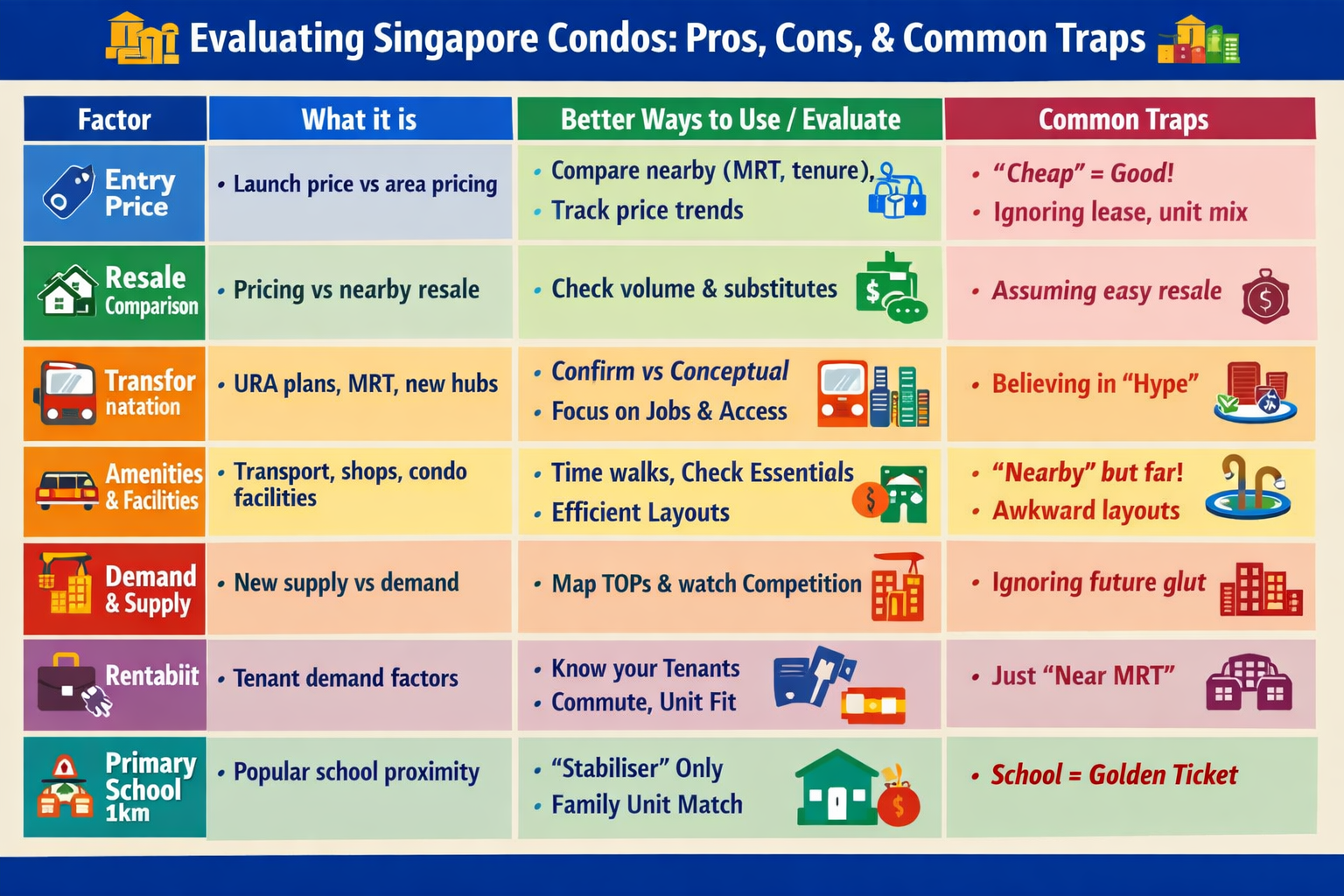
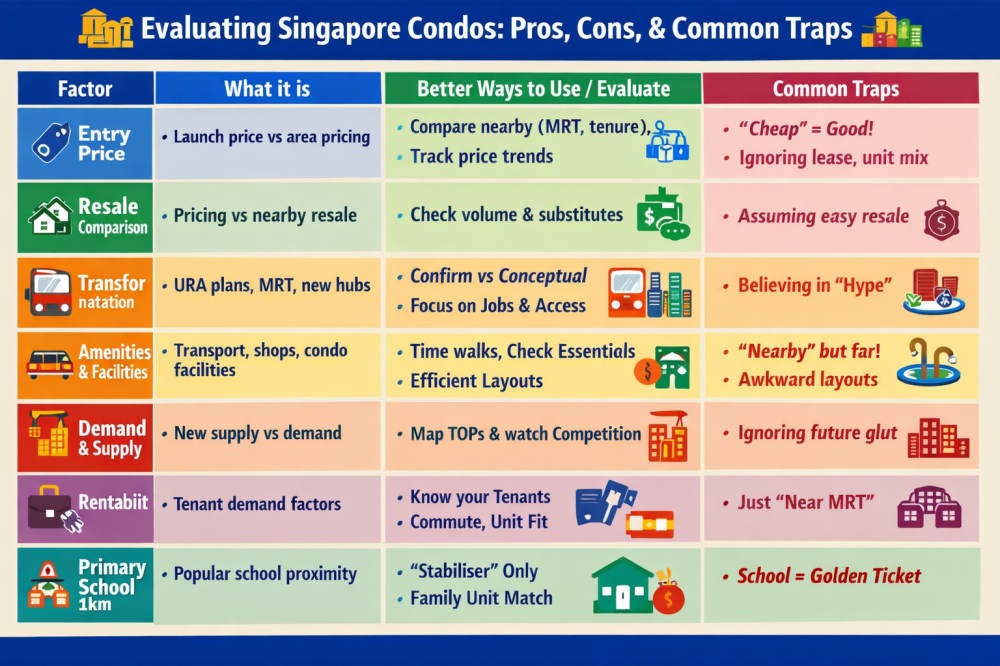
Another Practical Framework to Evaluate Singapore Condos: Pros, Cons, and What People Often Miss Singapore Condo Analysis Framework (7-factor scorecard) Use a simple 7-factor scorecard to judge a condo like an investment, not just a checklist, by asking three big questions: can you sell easily later (exit liquidity), how much can you lose if the market turns (downside risk), and can you comfortably hold it through a rough patch (holding power). Start with entry price by comparing the launch $PSF to truly similar condos in the same micro-area (same walk-to-MRT convenience, age, tenure, and positioning), and watch whether it stays fairly priced versus peers over time. Next, do a resale comparison to sanity-check your exit: look at nearby resale “substitutes,” how many units actually transact (liquidity), and whether prices are consistent or all over the place—thin volume and messy pricing make exits harder. Then consider transformation as optional upside, not a certainty: URA plans, new MRT lines, or redevelopment can take 5–15 years and may change, so give more weight to confirmed projects that clearly improve access, jobs, or daily amenities rather than early concepts. For amenities and facilities, focus on what improves day-to-day living and buyer appeal walkability to essentials and efficient layouts often matter more than “more facilities,” which can also mean higher maintenance fees. Under demand and supply, map what other projects are completing around the same time (TOP window), what unit types they add, and who will buy or rent there; high supply isn’t automatically bad, but high “like-for-like” competition (substitutability) is. For rentability, treat rental demand as your safety buffer: strong tenant appeal reduces vacancy risk and helps you hold longer, so estimate realistic rents based on who would live there and commute patterns, and use net yield after fees, taxes, and vacancy. Finally, a primary school within 1km is a bonus that can widen the buyer pool (especially families), but it’s not guaranteed because of balloting and it depends on school reputation and whether the unit type fits family demand—so treat it as supportive, not decisive. Overall, think of downside risk as driven mainly by entry price plus the upcoming supply and how easily buyers can switch to alternatives; exit liquidity comes from strong resale comps and a wide buyer pool; holding power depends on rentability, maintenance costs, and unit efficiency; and optional upside comes from transformation and the 1km school effect if they aren’t already priced in.



























.png.8ca4494efb524ce6c74028327651c792.png)